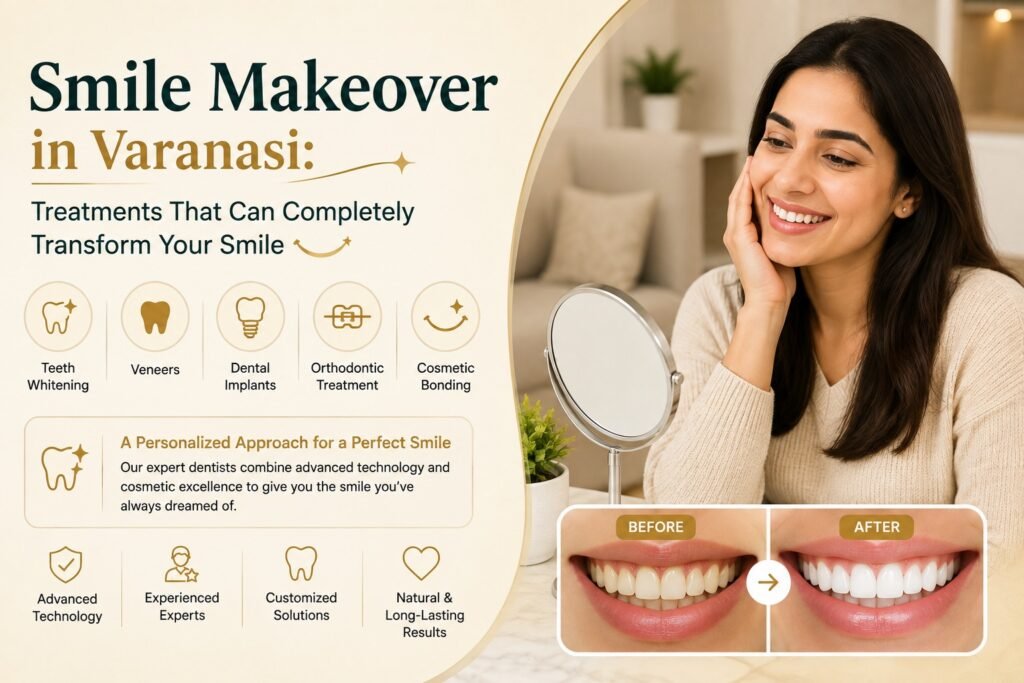
Smile Makeover in Varanasi: Treatments That Can Completely Transform Your Smile
What Is a Smile Makeover?
Quick Answer: A smile makeover is a personalized combination of cosmetic and restorative dental treatments designed to improve the appearance of the smile while considering oral health, tooth function, proportions, gum health and the patient’s goals. It is not one standard procedure; the treatment plan depends on the condition of the teeth and the desired outcome.
A person may dislike their smile for very different reasons. Teeth may be stained from years of tea or coffee consumption. One or two teeth may be chipped. Teeth may appear uneven, crowded, worn or misshapen. Gaps may affect the appearance of the smile, while old restorations may no longer match surrounding teeth.
A smile makeover brings these concerns together rather than treating every tooth independently.
At Cherian Clinic in Varanasi, the starting point should be an assessment of the patient’s dental condition, concerns and expectations before deciding whether whitening, bonding, veneers, crowns, orthodontic treatment or a combination is appropriate.
Importantly, cosmetic dentistry should not replace basic oral healthcare. Decay, gum disease and other active dental problems generally need attention before elective cosmetic treatment. The American Dental Association’s consumer guidance on veneers specifically notes that underlying decay or gum disease should be addressed first.
Practical tip: Do not choose a treatment simply because it looks impressive in a photograph. Choose the least invasive option that can reasonably address your specific dental concern.
Why Do People Consider a Smile Makeover in Varanasi?
Quick Answer: People consider smile makeovers for concerns such as tooth discoloration, chipped teeth, uneven tooth shape, gaps, worn teeth, mild alignment concerns or dissatisfaction with older dental restorations. A professional consultation helps determine whether cosmetic treatment is appropriate and whether oral health needs to be addressed first.
For some people, the motivation is an upcoming wedding or important event. Others may have avoided smiling in photographs for years because they are uncomfortable with stained, chipped or uneven teeth.
A smile makeover can also be about restoring confidence after dental wear or previous treatment.
Common concerns include:
- Stained or discoloured teeth
- Chipped or fractured front teeth
- Small or uneven-looking teeth
- Gaps between teeth
- Worn enamel or tooth edges
- Mismatched dental restorations
- Mild crowding or alignment concerns
- Irregular gum appearance
- A smile that looks disproportionate to the face
However, not every concern requires veneers or extensive treatment. For example, professional whitening may be sufficient for certain types of discoloration. The ADA notes that whitening can address both extrinsic and intrinsic staining, although sensitivity and gum irritation can occur.
Practical tip: During your consultation, explain what you dislike about your smile in everyday terms rather than asking for a specific procedure. This allows the dentist to consider alternatives.
Which Treatments Can Be Used in a Smile Makeover?
Quick Answer: Smile makeover treatment may involve teeth whitening, professional cleaning, composite bonding, veneers, crowns, orthodontic treatment or carefully planned combinations of these procedures. The appropriate treatment depends on tooth structure, oral health, bite, gum condition, discoloration, alignment and the patient’s aesthetic goals.
There is no universal “smile makeover package.”
Common options include:
| Treatment | Often considered for | Main consideration |
|---|---|---|
| Professional whitening | Tooth staining/discoloration | Works on natural teeth |
| Composite bonding | Small chips, shape changes, minor gaps | Conservative and repairable |
| Veneers | Shape, color, selected cosmetic concerns | Requires careful case selection |
| Crowns | Damaged or structurally compromised teeth | Covers the tooth more extensively |
| Orthodontics | Crowding, spacing and bite problems | Corrects tooth positioning |
| Gum contouring | Certain gum-line irregularities | Requires clinical assessment |
| Combined treatment | Multiple aesthetic concerns | Requires sequencing and planning |
The ADA explains that veneers cover the front surface of teeth, while crowns cover the tooth more extensively. Veneers may be made from porcelain or composite materials and are not reversible when enamel is removed.
This distinction matters because a treatment that works well for one patient may be unnecessarily invasive for another.
Example: A patient with healthy teeth and mild surface staining may benefit from professional whitening rather than veneers.
Smile Makeover vs Teeth Whitening: Which Is Better?
Quick Answer: Teeth whitening is generally a more focused treatment for improving the color of natural teeth, while a smile makeover addresses several aesthetic or functional concerns. If color is the only concern, whitening may be enough. If tooth shape, gaps, chips or alignment are also concerns, additional treatments may be considered.
Whitening and smile makeovers are sometimes treated as interchangeable terms, but they are not.
Teeth whitening
Whitening primarily changes tooth color. Professional whitening can be performed in a dental setting or through dentist-supervised home methods.
One important limitation is that whitening changes the color of natural teeth but does not whiten tooth-colored restorations such as crowns or some veneers. (ADA)
Smile makeover
A smile makeover considers the overall appearance of the smile, including:
- Color
- Tooth shape
- Tooth size
- Alignment
- Spacing
- Proportions
- Gum appearance
- Existing restorations
Practical tip: If your primary concern is yellow or stained natural teeth, ask whether whitening alone can solve the problem before considering more extensive cosmetic procedures.
Are Dental Veneers Suitable for a Smile Makeover?
Quick Answer: Dental veneers can be suitable for selected patients with concerns such as staining, chips, gaps or irregular tooth shape, but they are not appropriate for everyone. A dentist should assess tooth structure, gum health, bite, grinding habits and expectations before recommending veneers.
Veneers are thin, custom-made coverings placed over the front surface of teeth. They can change the apparent color, shape and proportions of selected teeth.
The ADA’s patient guidance states that veneers may improve the appearance of chipped, broken, stained, crooked or misshapen teeth and can mask some gaps.
But veneers require informed decision-making.
Potential considerations include:
- Enamel preparation may be required.
- Treatment may not be reversible.
- Veneers can chip, crack, loosen or wear over time.
- Grinding or clenching can affect suitability.
- Existing decay or gum disease should be addressed first.
- Maintenance remains important after treatment.
The goal should not be to create an unnaturally uniform smile. Good cosmetic planning considers facial characteristics, tooth proportions, gum display and the patient’s preferences.
Practical tip: Ask to see a proposed treatment plan and understand what will be changed before consenting to irreversible tooth preparation.
What Is Composite Bonding and When Can It Help?
Quick Answer: Composite bonding uses tooth-colored resin that is bonded and shaped directly on a tooth. It can be useful for selected minor chips, small gaps, changes in tooth contour and localized cosmetic corrections. It may require less removal of natural tooth structure than some veneer procedures.
Composite bonding can be an attractive option when the dental problem is relatively limited.
A dentist may use a tooth-colored composite material to reshape part of a tooth. The material is bonded to the tooth and then shaped, polished and adjusted.
Compared with porcelain veneers, composite approaches can sometimes be more conservative and easier to repair, although they have different durability, stain resistance and wear characteristics. The ADA’s veneer guidance distinguishes composite veneers from porcelain veneers in terms of material properties and maintenance considerations.
Possible applications
- Small chips
- Minor gaps
- Uneven edges
- Localized shape correction
- Small cosmetic imperfections
Example: If one front tooth has a small chip but is otherwise healthy, direct composite bonding may be considered instead of preparing several teeth for veneers.
Practical tip: Ask how much natural tooth structure would be altered with each option and why the dentist recommends one approach over another.
Can Orthodontic Treatment Be Part of a Smile Makeover?
Quick Answer: Yes. Orthodontic treatment may be appropriate when tooth position, crowding, spacing or bite contributes to the appearance of the smile. Moving teeth can address the underlying alignment rather than simply disguising it with restorative treatment.
A smile that appears uneven is not always a cosmetic problem alone.
Crowded teeth may be difficult to clean. An abnormal bite can contribute to tooth wear and other oral health concerns. The ADA notes that orthodontic treatment is used for malocclusion, including crooked or crowded teeth, and can contribute to a healthier mouth.
Depending on the case, treatment may involve conventional braces or other orthodontic approaches.
This is particularly important for patients who are considering veneers simply to make crowded teeth look straighter.
A useful comparison
| Approach | Primary purpose |
|---|---|
| Orthodontics | Moves teeth |
| Whitening | Changes natural tooth color |
| Bonding | Changes selected tooth shape |
| Veneers | Changes front surface appearance |
| Crowns | Restores more extensively damaged teeth |
Practical tip: If alignment is a major concern, ask whether orthodontic correction should come before cosmetic restorations.
How Does a Smile Makeover Consultation Work?
Quick Answer: A smile makeover consultation normally begins with a discussion of concerns and goals, followed by a clinical examination and, when appropriate, photographs, scans or radiographs. The dentist then evaluates oral health, tooth structure, gums, bite and aesthetic factors before discussing suitable treatment options.
A thoughtful consultation is one of the most important parts of cosmetic dentistry.
Step 1: Discuss your goals
Tell the dental team what you want to change.
For example:
“My teeth look too yellow in photographs.”
or:
“I have a gap between my front teeth.”
Step 2: Examine oral health
The dentist checks for issues such as:
- Tooth decay
- Gum disease
- Damaged teeth
- Existing restorations
- Tooth wear
- Bite problems
Step 3: Evaluate aesthetics
The dentist considers:
- Tooth proportions
- Tooth color
- Shape
- Gum display
- Facial appearance
- Smile line
- Symmetry
Step 4: Discuss treatment alternatives
You should understand why a particular treatment is recommended and what alternatives exist.
Step 5: Plan the sequence
Some cases require multiple stages.
For example:
Dental cleaning → gum treatment → whitening → bonding/veneers → final review
The sequence depends on the clinical situation.
How Much Does a Smile Makeover Cost in Varanasi?
Quick Answer: There is no single fixed price for a smile makeover because the cost depends on the number of teeth treated, procedures required, materials selected, laboratory work, clinical complexity and follow-up care. A personalized consultation is more reliable than comparing a single advertised package price.
Patients searching for “smile makeover cost in Varanasi” often expect one number.
In reality, two patients may require completely different treatment plans.
For example:
- Patient A may need professional whitening.
- Patient B may need bonding on two teeth.
- Patient C may need orthodontic treatment.
- Patient D may require veneers on selected teeth.
- Patient E may need restorative treatment before cosmetic treatment can begin.
Therefore, the appropriate way to compare prices is to compare complete treatment plans, not just individual procedure prices.
Ask about:
- Consultation and diagnostic charges
- Number of teeth involved
- Material being used
- Laboratory charges
- Temporary restorations, if applicable
- Follow-up visits
- Repairs or maintenance
- Any additional treatment required before cosmetic work
Practical tip: Be cautious of unusually low-cost cosmetic offers that do not clearly explain diagnosis, materials, dentist involvement or follow-up care. The ADA warns that unsupervised or unlicensed dental treatment can create significant risks.
What Makes a Smile Makeover Look Natural?
Quick Answer: A natural-looking smile makeover depends on appropriate tooth proportions, color selection, surface texture, symmetry, gum appearance, bite and the relationship between the teeth and the patient’s facial features. The objective should be a balanced smile rather than teeth that look identical, oversized or artificially bright.
Modern cosmetic dentistry is not simply about making teeth extremely white.
A natural smile contains subtle variations.
Dentists and dental laboratories consider factors such as:
- Shade
- Translucency
- Tooth length
- Tooth width
- Incisal edges
- Surface texture
- Gum contours
- Smile line
- Facial proportions
Professional case planning is particularly important when several front teeth are being treated.
An ADA-published clinical case illustrates how comprehensive aesthetic dentistry can combine procedures such as soft-tissue management, whitening, ceramic veneers and composite restorations according to the patient’s specific anatomy and goals.
Practical tip: Tell your dentist whether you prefer a subtle, natural appearance or a brighter cosmetic look. “Natural” and “white” are not necessarily the same thing.
What Are the Risks and Limitations of Smile Makeovers?
Quick Answer: Cosmetic dental treatment can involve limitations such as sensitivity, restoration damage, maintenance requirements, changes in tooth structure and the possibility of future repair or replacement. The risks depend on the procedure. A responsible treatment plan should explain benefits, limitations, alternatives and potential complications before treatment begins.
A trustworthy cosmetic consultation should never promise a perfect result.
Important considerations
Whitening: Temporary tooth sensitivity and gum irritation can occur.
Veneers: They may chip, crack, loosen or require replacement over time. They are not reversible when enamel has been removed.
Composite bonding: The material may be more susceptible to staining or wear than some ceramic alternatives.
Crowns: Crowns involve more extensive restoration of the tooth and should not be selected purely for cosmetic reasons when a more conservative option is appropriate.
Orthodontics: Treatment takes time and requires patient compliance and maintenance.
The safest approach is not necessarily the treatment with the most dramatic visual change. It is the treatment that appropriately addresses the patient’s condition while preserving healthy structures wherever possible.
Why Choose Cherian Clinic for a Smile Makeover in Varanasi?
Quick Answer: Cherian Clinic in Varanasi provides dental care alongside skin and hair services, with a patient-focused approach to assessment and treatment planning. Dr. Navneet Kaur is presented by the clinic as a BDS-qualified dental surgeon, cosmetologist and dental coach with more than 15 years of professional experience.
According to the professional information provided for Cherian Clinic, Dr. Navneet Kaur completed her Bachelor of Dental Surgery (BDS) from Panjab University, Chandigarh, in 2011. Her stated professional experience includes work as an Associate Dental Surgeon at Fortis Hospital, Chandigarh, Medical Director and Dental Coach at Daffodil Dental in New Delhi, and Director at Cherian Clinic in Varanasi.
Her additional training listed by the clinic includes Dental Implantology and Facial Aesthetics.
Her experience in clinical operations, treatment protocols, team training and patient care is relevant to a practice where cosmetic dentistry needs to be planned alongside overall oral health.
Cherian Clinic’s approach can be positioned around:
- Clinical assessment before cosmetic treatment
- Personalized treatment planning
- Dental and aesthetic care
- Modern clinical facilities
- Patient education
- Treatment sequencing
- Focus on preserving healthy tooth structure
- Follow-up and maintenance guidance
The clinic also uses patient feedback and reviews as trust signals. However, individual testimonials should be interpreted as patient experiences rather than guarantees of a particular clinical result.
Practical tip: When selecting a cosmetic dentist in Varanasi, evaluate the dentist’s qualifications, experience, diagnostic process, treatment alternatives, communication and follow-up—not only photographs or promotional offers.
Patient Experience: Why Reviews Matter
Quick Answer: Patient reviews can help prospective patients understand how a clinic communicates, manages appointments, explains treatment and supports patients during their care journey. Reviews are useful trust signals, but they should complement—not replace—professional qualifications, clinical assessment and transparent treatment information.
Patients often search:
- “Best smile makeover dentist in Varanasi”
- “Smile makeover clinic near me”
- “Cosmetic dentist in Varanasi reviews”
- “Dental veneers Varanasi reviews”
Reviews can provide insight into the patient experience.
For example, patients may discuss:
- Communication
- Appointment experience
- Comfort
- Staff behaviour
- Treatment explanations
- Follow-up
- Overall satisfaction
Cherian Clinic has shared patient feedback across its dental and healthcare communication channels. Those experiences can help prospective patients understand how other people describe their interactions with the clinic, but individual experiences vary.
Trust principle: A review should never be presented as proof that every patient will achieve the same result.
Smile Makeover in Varanasi: A Practical Decision Guide
Quick Answer: The right smile makeover depends on the problem you want to solve. Whitening is primarily for color, bonding can address selected minor shape defects, veneers can change the appearance of selected front teeth, orthodontics addresses tooth position, and crowns are generally used when a tooth requires more substantial restoration.
If your main concern is:
“My teeth are stained.”
Ask about professional whitening and the cause of discoloration.
“One tooth is chipped.”
Ask whether bonding or another conservative restoration could work.
“My teeth are crowded.”
Ask whether orthodontic treatment is more appropriate.
“My front teeth have irregular shapes.”
Discuss bonding, veneers or other restorative options.
“My old crowns do not match.”
A dentist can assess the restorations and surrounding teeth before recommending replacement.
“I want a complete smile transformation.”
A comprehensive smile analysis may be appropriate.
This problem-first approach is more reliable than selecting a procedure because it is currently popular online.
How to Maintain Your Smile After Cosmetic Treatment
Quick Answer: Cosmetic dental treatment does not eliminate the need for everyday oral care. Brushing twice daily with fluoride toothpaste, cleaning between teeth, attending dental reviews and avoiding habits that can damage restorations help support long-term oral health and the condition of cosmetic dental work.
After treatment:
- Brush twice a day.
- Clean between teeth daily.
- Attend recommended dental examinations.
- Follow professional maintenance instructions.
- Avoid biting hard non-food objects.
- Manage teeth grinding if present.
- Discuss sports mouthguards when appropriate.
- Limit frequent exposure to staining foods and drinks if advised.
- Report changes such as sensitivity, looseness or damage.
The ADA specifically recommends maintaining oral hygiene around veneers because teeth can still develop cavities around or underneath restorations.
A smile makeover is therefore not the end of dental care. It is part of a longer oral-health plan.
Smile Makeover in Varanasi Frequently Asked Questions
1. What is a smile makeover in Varanasi?
A smile makeover is a customized dental treatment plan designed to improve the appearance of the smile. Depending on the patient’s needs, it may involve whitening, bonding, veneers, orthodontics, crowns or combinations of treatments.
2. How do I know if I need a smile makeover?
You may consider a consultation if you are concerned about stained, chipped, uneven, worn, crowded or misshapen teeth. A dentist can determine whether cosmetic treatment, restorative care, orthodontics or simple preventive treatment is appropriate.
3. What is the best treatment for a smile makeover?
There is no single best treatment for everyone. Whitening may be suitable for certain discoloration, bonding for selected minor defects, veneers for specific cosmetic concerns and orthodontics for alignment problems.
4. Are veneers necessary for a smile makeover?
No. Veneers are only one possible option. Some patients may achieve their desired improvement with whitening, bonding or orthodontic treatment, depending on their dental condition and goals.
5. Is a smile makeover permanent?
No cosmetic dental treatment should be described as permanently maintenance-free. The longevity of treatment depends on the procedure, materials, oral hygiene, bite, habits and ongoing dental care.
6. Is teeth whitening included in a smile makeover?
It can be. Whitening may be used when tooth color is an important concern. However, whether it is appropriate depends on the cause of discoloration and the condition of the teeth and existing restorations.
7. Can a smile makeover fix chipped teeth?
In selected cases, yes. Small chips may sometimes be treated with composite bonding, while larger or structurally compromised teeth may require a different restorative approach.
8. Can a smile makeover close gaps between teeth?
It can sometimes. Depending on the size and cause of the gap, options may include orthodontics, bonding or veneers. The dentist should first determine why the gap exists.
9. Can crowded teeth be treated with veneers?
Veneers can sometimes change the appearance of mildly irregular teeth, but they do not actually move teeth. Orthodontic treatment may be more appropriate when tooth positioning is the primary concern.
10. How much does a smile makeover cost in Varanasi?
The cost varies according to the number of teeth, procedures, materials, laboratory work and clinical complexity. A consultation and individualized treatment plan are needed to provide a meaningful estimate.
11. Is a smile makeover painful?
Discomfort depends on the procedure. Some treatments, such as whitening, may cause temporary sensitivity, while procedures involving tooth preparation may require local anesthesia. Your dentist should explain expected sensations before treatment.
12. Where can I get a smile makeover consultation in Varanasi?
Patients looking for a smile makeover consultation in Varanasi can contact Cherian Clinic to discuss their dental concerns, undergo an assessment and understand suitable treatment options.
Final Takeaway
A smile makeover is not simply about getting whiter teeth. It is about understanding what is affecting your smile and choosing an appropriate solution.
For one person, professional whitening may be enough. Another may benefit from bonding. Someone with alignment concerns may need orthodontic treatment, while selected patients may be candidates for veneers or restorative dentistry.
The most important step is therefore the consultation.
At Cherian Clinic, Varanasi, patients can discuss their smile concerns with the dental team and explore treatment options based on their oral health, expectations and individual needs.
A confident smile should look like your smile—just thoughtfully cared for
![# Root Canal Treatment in Varanasi: Cost, Procedure, Benefits & Recovery Guide **SEO Title:** Root Canal Treatment in Varanasi: Cost, Procedure, Benefits & Recovery Guide | Cherian Clinic **Meta Description:** Learn about root canal treatment in Varanasi, including symptoms, procedure, cost factors, benefits, recovery, crowns, alternatives and FAQs from Cherian Clinic. **Primary Keyword:** Root Canal Treatment in Varanasi **Search Intent:** Informational + Commercial + Local + Transactional > **Medical note:** This guide is for patient education and does not replace an examination or diagnosis by a qualified dental professional. Root canal treatment is recommended only when clinical findings support the diagnosis. ## Introduction: When Tooth Pain Changes Your Daily Life A toothache can begin as something easy to ignore: sensitivity while drinking tea, discomfort when chewing, or a dull pain that comes and goes. Then one night, the pain becomes strong enough to interrupt sleep. Many patients ask the same question: **“Can the tooth be saved, or will it have to be removed?”** In many cases, root canal treatment is designed specifically to **save a natural tooth when the pulp inside it becomes inflamed or infected**. The procedure removes the damaged pulp, cleans and disinfects the internal root canal system, seals it, and then restores the tooth so it can function again. ([American Association of Endodontists][1]) For patients searching for **root canal treatment in Varanasi**, the important decision is not simply finding the lowest price. Diagnosis, treatment planning, clinical expertise, infection control, restoration quality and appropriate follow-up all matter. At **Cherian Clinic, Sundarpur, Varanasi**, root canal treatment is listed among its dental services. The clinic states that its dental care approach combines experienced professionals, modern technology and personalized treatment planning. ([cherianclinic.com][2]) --- ## What Is Root Canal Treatment? ### Quick Answer **Root canal treatment is a procedure used to treat a tooth when the pulp inside it becomes inflamed or infected.** The dentist removes the affected pulp, cleans and disinfects the canals, fills and seals them, and then restores the tooth. The primary goal is to control infection and preserve the natural tooth whenever possible. ([American Association of Endodontists][1]) The inside of a mature tooth contains pulp, which includes nerves, blood vessels and connective tissue. Deep decay, cracks, repeated dental procedures or trauma can damage this tissue. If the inflammation or infection is not appropriately treated, it may progress to an abscess or cause increasing pain and swelling. ([American Association of Endodontists][3]) A root canal does **not** mean that the entire tooth is removed. Instead, the diseased tissue inside the tooth is treated while the natural tooth structure is retained. **Practical tip:** Do not assume every toothache requires a root canal. A dentist needs to examine the tooth and determine the actual cause. --- # 1. When Do You Need a Root Canal? ### Quick Answer A root canal may be recommended when the dental pulp is irreversibly inflamed or infected. Common warning signs include lingering sensitivity to hot or cold, pain while biting, swelling, tenderness, deep decay, cracks or changes in tooth colour. However, symptoms vary, and some infected teeth may produce little or no pain. ([American Association of Endodontists][3]) ### Common symptoms include: * Severe or persistent toothache * Pain while chewing or biting * Lingering sensitivity to hot or cold * Swollen or tender gums * A pimple or draining area on the gum * Deep dental decay * A cracked or chipped tooth * Darkening of a tooth * Previous extensive dental treatment on the same tooth Not every symptom automatically means you need root canal treatment. For example, tooth sensitivity can have several causes, including exposed dentin, gum recession or other dental conditions. **Example:** A patient with deep decay may initially experience sensitivity to cold. If the decay progresses toward the pulp, the symptoms can become more persistent and painful. **Practical tip:** If tooth pain lasts, repeatedly returns, or is accompanied by swelling, arrange a dental examination instead of relying only on painkillers. --- # 2. Why Does a Tooth Need Root Canal Treatment? ### Quick Answer The most common reasons for root canal treatment include **deep tooth decay, cracks or chips, repeated dental procedures and dental trauma**. These problems can allow bacteria or inflammation to affect the pulp. If the pulp cannot recover, treatment may be required to remove the diseased tissue and preserve the tooth. ([American Association of Endodontists][4]) The process can happen gradually. For example: **Cavity → deeper decay → pulp irritation → inflammation/infection → pain or abscess** However, this is not the only pathway. A traumatic injury can damage the pulp even when there is no obvious visible crack. Professional diagnosis therefore matters. **Expert insight:** Treating the underlying dental problem is different from temporarily controlling symptoms. Pain relief may make you feel better, but it does not necessarily eliminate the source of an infection. **Practical tip:** Do not wait for severe pain before seeking professional evaluation. --- # 3. How Is Root Canal Treatment Performed Step by Step? ### Quick Answer Root canal treatment generally involves examination and diagnosis, local anaesthesia, access to the tooth, removal of infected or inflamed pulp, cleaning and shaping of the canals, filling and sealing the canal space, and finally restoring the tooth. The exact sequence and number of appointments depend on the tooth and its condition. ([American Association of Endodontists][1]) ### Step 1: Examination and Diagnosis The dentist evaluates your symptoms and examines the tooth. Dental imaging may be used when clinically appropriate to assess the tooth and surrounding structures. ### Step 2: Local Anaesthesia Local anaesthesia is generally used so the patient remains awake but the treatment area is numbed. ([nhs.uk][5]) ### Step 3: Accessing the Tooth A small opening is made to reach the pulp chamber and root canals. ### Step 4: Removing the Diseased Pulp The damaged or infected pulp is removed. ### Step 5: Cleaning and Shaping The canals are carefully cleaned, disinfected and shaped to prepare them for sealing. ### Step 6: Filling and Sealing The cleaned canal system is filled and sealed to reduce the risk of reinfection. A commonly used filling material is gutta-percha. ([American Association of Endodontists][6]) ### Step 7: Final Restoration The tooth may require a permanent filling or crown depending on its structural condition. **Practical tip:** Completing the recommended final restoration is an important part of protecting a treated tooth. --- # 4. Is Root Canal Treatment Painful? ### Quick Answer Modern root canal treatment is performed with local anaesthesia and is generally designed to be comfortable. Some patients may experience tenderness or mild discomfort after treatment as the surrounding tissues recover. The experience can vary depending on the tooth, infection and individual sensitivity. ([American Association of Endodontists][6]) The fear surrounding root canals is often greater than the procedure itself. The American Association of Endodontists notes that modern anaesthesia and techniques make root canal treatment highly comfortable for most patients. ([American Association of Endodontists][6]) After treatment, some soreness can occur. This does not necessarily mean the treatment has failed. **Example:** A tooth with significant inflammation may remain tender for a short period even after the infected pulp has been removed. **Practical tip:** Tell your dentist about dental anxiety, previous difficult dental experiences or pain concerns before treatment. Communication can help the clinical team plan a more comfortable experience. --- # 5. How Many Appointments Does Root Canal Treatment Take? ### Quick Answer The number of appointments is **case-dependent**. Some root canal treatments can be completed efficiently in one appointment, while others require two or more visits because of infection, tooth anatomy, treatment complexity or the need for an interim restoration. There is no single appointment schedule suitable for every patient. ([American Association of Endodontists][1]) The number of canals, infection status, tooth location and complexity can influence treatment time. Cherian Clinic promotes root canal treatment among its dental services and describes its approach as using personalized treatment planning. ([cherianclinic.com][2]) A complicated molar should not be rushed simply to meet a one-visit target. **Practical tip:** Ask your dentist: 1. How many visits are expected? 2. What is the condition of the tooth? 3. Will a crown be required? 4. What happens if additional infection is found? 5. What is included in the quoted treatment cost? --- # 6. Root Canal Treatment Cost in Varanasi: What Determines the Price? ### Quick Answer The **cost of root canal treatment in Varanasi varies from patient to patient**. Factors can include the tooth involved, number of canals, infection severity, diagnostic requirements, treatment complexity, materials, restoration type and whether additional procedures are necessary. A reliable price should be provided after clinical assessment rather than guessed from symptoms alone. ### Major cost factors | Factor | Why it matters | | --------------------- | ------------------------------------------------------ | | Type of tooth | Front teeth and molars have different anatomy | | Number of canals | More complex canal systems can require additional work | | Infection | Infection may affect treatment planning | | Imaging | Diagnostic imaging may be clinically necessary | | Restoration | A filling or crown may be required after RCT | | Retreatment | Previously treated teeth can be more complex | | Additional procedures | Some cases require further treatment | A common mistake is comparing only the **root canal fee**. The complete treatment may include consultation, diagnostic imaging, root canal therapy and the final restoration. Therefore, patients searching for **“root canal treatment cost near me”** or **“RCT cost in Varanasi”** should ask for a treatment-wise estimate. **At Cherian Clinic:** Patients can contact the clinic in Sundarpur, Varanasi, for an assessment and treatment plan. The clinic lists its contact number as **+91-8130014544**. ([cherianclinic.com][7]) **Practical tip:** Choose transparency over an artificially low headline price. Ask what the quoted amount includes. --- # 7. Root Canal vs Tooth Extraction: Which Is Better? ### Quick Answer When a natural tooth can be predictably restored, root canal treatment may offer the advantage of preserving the tooth rather than removing it. Extraction may be necessary when a tooth cannot be predictably saved because of factors such as severe structural damage. The appropriate choice depends on examination and prognosis. ([American Association of Endodontists][6]) | Root Canal | Extraction | | ---------------------------------------------- | -------------------------------------------- | | Attempts to preserve natural tooth | Removes the natural tooth | | Maintains natural tooth structure | Creates a missing-tooth space | | Usually followed by restoration | May require implant, bridge or denture | | Can preserve normal chewing function | Replacement may require additional treatment | | Requires appropriate remaining tooth structure | May be necessary when tooth cannot be saved | The American Association of Endodontists emphasizes that saving the natural tooth can help maintain normal chewing and reduce the need for additional dental work. ([American Association of Endodontists][6]) However, **root canal treatment is not always the correct choice**. A dentist should explain whether the tooth is restorable and discuss alternatives when appropriate. **Practical tip:** Ask, “Is my tooth predictably restorable, and what are the alternatives?” before deciding on extraction. --- # 8. Why Is a Crown Sometimes Needed After Root Canal Treatment? ### Quick Answer A tooth that has undergone root canal treatment may need a crown or another appropriate restoration to protect it, particularly when substantial tooth structure has been lost. The final restoration depends on the tooth's location, remaining structure, biting forces and clinical assessment. ([American Association of Endodontists][1]) The root canal treats the inside of the tooth, but the tooth still needs structural protection. Posterior teeth such as premolars and molars experience significant chewing forces. If a large amount of tooth structure has been lost, a dentist may recommend a crown. ### Treatment sequence may therefore be: **Diagnosis → Root canal → Temporary/permanent restoration → Final crown when indicated → Follow-up** **Example:** A molar with extensive decay may require both root canal therapy and a crown to restore function and protect the remaining tooth structure. **Practical tip:** Do not treat the crown as an optional cosmetic add-on without asking why it has been recommended. Its role may be functional protection. --- # 9. What Is Recovery Like After a Root Canal? ### Quick Answer Most patients can return to normal activities relatively quickly, although the treated tooth may feel tender or the mouth may remain numb for several hours after local anaesthesia. Follow your dentist's instructions, attend scheduled follow-ups and avoid putting unnecessary stress on a tooth awaiting its final restoration. ([American Association of Endodontists][1]) ### After-treatment guidance * Wait until numbness has worn off before eating. * Follow the dentist's medication instructions. * Avoid biting hard foods on a temporarily restored tooth. * Maintain normal oral hygiene unless your dentist advises otherwise. * Attend the recommended follow-up. * Complete the final restoration when advised. The NHS notes that soreness or swelling around the tooth may occur and should generally improve; persistent or worsening symptoms require professional review. ([nhs.uk][5]) **When should you contact your dentist?** Contact your dental provider if you develop significant swelling, worsening pain, fever, difficulty swallowing or other concerning symptoms. **Practical tip:** Do not ignore a temporary filling or postpone the final restoration indefinitely. --- # 10. Can Root Canal Treatment Save a Natural Tooth? ### Quick Answer Yes. One of the central purposes of root canal treatment is to **save a natural tooth that might otherwise require extraction**. After the infected pulp is removed and the canal is cleaned, disinfected and sealed, the tooth can be restored and continue functioning. With appropriate care, many treated teeth can remain functional for many years. ([American Association of Endodontists][6]) Keeping a natural tooth can provide practical advantages: * Natural appearance * Normal chewing * Natural tooth position * Reduced need for tooth replacement * Preservation of surrounding structures But success depends on more than the root canal itself. The tooth needs adequate remaining structure, appropriate treatment, a good final restoration and ongoing oral hygiene. **Practical tip:** Think of root canal treatment as part of a larger tooth-saving plan rather than an isolated procedure. --- # 11. What Makes a Good Root Canal Treatment Clinic in Varanasi? ### Quick Answer A suitable root canal provider should offer accurate diagnosis, clear treatment planning, appropriate technology, infection-control practices, transparent communication and suitable restorative follow-up. Patients should also consider the clinician's qualifications and experience rather than choosing a clinic solely because it advertises the lowest RCT price. For patients comparing a **root canal dentist in Varanasi**, consider: ### 1. Clinical qualifications Check the dentist's professional education, registration and relevant experience. ### 2. Diagnostic capability A proper diagnosis should come before treatment. ### 3. Modern clinical equipment Appropriate dental technology can support diagnosis and treatment, although technology should complement—not replace—professional clinical judgment. ### 4. Sterilization and hygiene Dental instruments and treatment environments should follow appropriate infection-control protocols. ### 5. Transparent communication The dentist should explain: * Diagnosis * Treatment options * Expected appointments * Restoration requirements * Risks and limitations * Estimated costs ### 6. Patient experience Reviews can provide useful information about communication, comfort and service—but they should not replace professional evaluation. Cherian Clinic identifies itself as a dental, skin and hair care centre in **Sundarpur, Varanasi, Uttar Pradesh**, and its website currently displays patient-review information and describes personalized dental treatment. ([cherianclinic.com][2]) **Practical tip:** Compare clinics on clinical quality and transparency—not just price. --- # 12. Why Choose Cherian Clinic for Root Canal Treatment in Varanasi? ### Quick Answer Cherian Clinic is a multi-specialty dental, skin and hair care clinic located in Sundarpur, Varanasi. Its website lists root canal treatment among its dental services and highlights personalized treatment planning, modern technology and experienced dental care. Patients can contact the clinic for an examination to determine whether root canal treatment is appropriate. ([cherianclinic.com][2]) ### Clinical leadership Cherian Clinic identifies **Dr. Navneet Kaur** as its Director and describes her as having more than 15 years of professional experience. Her qualifications and professional background include a **Bachelor of Dental Surgery (BDS)** and training in dental implantology and facial aesthetics, based on the professional information provided by the clinic. Her experience includes clinical leadership, patient-care systems, treatment protocols and dental practice management. ### Patient-focused approach The clinic emphasizes: * Personalized treatment planning * Modern dental technology * Patient communication * Comfortable clinical care * Dental treatment for different age groups * Preventive and restorative services The clinic's website currently reports **4.9 average rating, 200+ reviews and 5K+ patients treated**; these are clinic-reported figures and may change over time. ([cherianclinic.com][2]) **Trust principle:** A review score can help patients compare experiences, but treatment decisions should always be based on individual clinical assessment. --- # Root Canal Treatment in Varanasi: Patient Decision Checklist Before booking treatment, ask these questions: ### Diagnosis * What is causing my tooth pain? * Is the pulp infected or inflamed? * Is root canal treatment definitely indicated? * Is the tooth restorable? ### Treatment * How many appointments may be needed? * What technology will be used? * Will I need a temporary filling? * Will I need a crown? ### Cost * What is included in the quoted cost? * Are X-rays included? * Is the final crown included? * Could additional treatment be required? ### Recovery * How long should sensitivity last? * What should I avoid eating? * When should I return? * What symptoms require urgent review? These questions make the consultation more useful and help patients make informed decisions. --- # Root Canal Treatment: Pros and Cons | Advantages | Considerations | | -------------------------------- | ------------------------------------- | | Can preserve a natural tooth | Requires professional diagnosis | | Treats infected pulp | May require more than one appointment | | Can restore chewing function | Final restoration may be necessary | | Avoids immediate extraction | Complex cases can be challenging | | Maintains natural tooth position | Treatment cost varies by case | The goal is not simply to complete a procedure. The goal is to achieve a healthy, functional and appropriately restored tooth. --- # Frequently Asked Questions About Root Canal Treatment in Varanasi ## 1. How much does root canal treatment cost in Varanasi? There is no single price that applies to every patient. Cost depends on the tooth, number of canals, complexity, infection, diagnostic requirements and final restoration. A dental examination is the best way to receive a case-specific estimate. ## 2. Is root canal treatment painful? Modern root canal treatment is performed using local anaesthesia and is generally designed to be comfortable. Mild tenderness after treatment can occur and usually improves as the tissues recover. ([American Association of Endodontists][6]) ## 3. How long does root canal treatment take? Treatment time varies. Some cases can be completed efficiently in one visit, while others require multiple appointments depending on infection, tooth anatomy and complexity. ([nhs.uk][5]) ## 4. Do I need a crown after root canal treatment? A crown may be recommended when substantial tooth structure has been lost or when additional protection is appropriate. The need depends on the tooth and its remaining structure. ## 5. Can a root canal fail? Root canal treatment can sometimes require retreatment or additional procedures. Persistent infection, complex anatomy, cracks or problems with the restoration can contribute to treatment difficulties. ## 6. Is extraction better than root canal treatment? Not necessarily. When a tooth is predictably restorable, preserving it may offer important functional benefits. Extraction may be recommended when the tooth cannot be predictably saved. ([American Association of Endodontists][8]) ## 7. Can I eat normally after a root canal? Follow your dentist's instructions. If the area is still numb, wait until sensation returns before eating. Avoid putting excessive force on a tooth that has a temporary restoration. ## 8. Can a tooth need a root canal without severe pain? Yes. Pulp damage or infection does not always cause severe symptoms. A dental examination is necessary when there are persistent concerns. ## 9. Where can I get root canal treatment in Varanasi? Cherian Clinic provides dental care in **Sundarpur, Varanasi, Uttar Pradesh**, and lists root canal treatment among its dental services. ([cherianclinic.com][2]) ## 10. How do I book a root canal consultation at Cherian Clinic? Patients can contact Cherian Clinic at **+91-8130014544** or visit its Sundarpur, Varanasi location for a dental consultation. ([cherianclinic.com][7]) --- # Internal Linking Recommendations for Cherian Clinic For stronger topical authority and user navigation, link this article naturally to: * **Dental Treatment in Varanasi** — anchor: *dental treatments in Varanasi* * **Dental Checkup in Varanasi** — anchor: *dental checkup in Varanasi* * **Teeth Cleaning & Scaling** — anchor: *professional teeth cleaning* * **Dental Implants in Varanasi** — anchor: *dental implants in Varanasi* * **Dental Crowns & Bridges** — anchor: *dental crowns after root canal* * **Emergency Dental Care** — anchor: *emergency dentist in Varanasi* * **Why Regular Dental Checkups Are Important** — anchor: *importance of regular dental checkups* Cherian Clinic's website currently provides location-specific dental service pages, including root canal treatment pages for areas such as Sundarpur, Bhelupur, Lanka, Durgakund, Mahmoorganj and Sigra. ([cherianclinic.com][2]) --- # Recommended Schema Markup For this article, the strongest structured-data combination would be: 1. **Article Schema** — identifies the article and author. 2. **Person Schema** — for Dr. Navneet Kaur, using only verified professional information. 3. **LocalBusiness/Dentist Schema** — for Cherian Clinic's physical location. 4. **Breadcrumb Schema** — improves site hierarchy. 5. **FAQPage Schema** — only when the visible FAQ content is actually present on the page. 6. **Review/AggregateRating Schema** — use carefully and only when the reviews and rating meet Google's structured-data requirements and are genuinely displayed on the page. Avoid adding schema simply to increase the number of markup types. Structured data should accurately represent visible, verifiable information. --- # AI Search & AEO Optimization Checklist This article is structured to provide clear answers for: * **“What is root canal treatment?”** * **“When do I need an RCT?”** * **“Is root canal painful?”** * **“How long does RCT take?”** * **“What is root canal treatment cost in Varanasi?”** * **“RCT vs extraction?”** * **“Do I need a crown after RCT?”** * **“How long is root canal recovery?”** * **“Where can I get root canal treatment near me?”** * **“How do I choose a root canal dentist in Varanasi?”** The content uses direct definitions, step-by-step treatment information, comparison tables, cost factors, local information, professional context, FAQs and transparent limitations—formats that make information easier for both readers and answer-oriented search systems to understand. --- # Conclusion: Treat the Tooth, Not Just the Pain Root canal treatment is fundamentally about **saving and restoring a natural tooth when the pulp has become seriously inflamed or infected**. Modern techniques and local anaesthesia have made treatment substantially more comfortable than the outdated image many people associate with a “root canal.” ([American Association of Endodontists][6]) The most important step is early professional evaluation. Persistent tooth pain, lingering sensitivity, swelling or discomfort while chewing should not simply be ignored. For patients searching for **root canal treatment in Varanasi**, cost is one consideration—but it should not be the only one. Diagnosis, clinical experience, treatment planning, infection control, restoration quality, transparency and follow-up are equally important. **Cherian Clinic in Sundarpur, Varanasi** provides dental services including root canal treatment and offers consultations to help patients understand their treatment options. ([cherianclinic.com][2]) **A painful tooth does not always mean a lost tooth. In many cases, the right diagnosis and timely treatment can help preserve your natural smile.** **Author:** Dr. Navneet Kaur, BDS — Director, Cherian Clinic **Location:** N-13/35 A-12, Brij Enclave, Sundarpur, Varanasi, Uttar Pradesh, India **Consultation:** +91-8130014544 ([cherianclinic.com][7]) **Trusted references:** American Association of Endodontists patient education resources and NHS clinical guidance on root canal treatment. ([American Association of Endodontists][1]) **Official clinic information:** [Cherian Clinic](https://cherianclinic.com/?utm_source=chatgpt.com) [1]: https://www.aae.org/patients/root-canal-treatment/what-is-a-root-canal/?utm_source=chatgpt.com "What is a Root Canal? - American Association of Endodontists" [2]: https://cherianclinic.com/?utm_source=chatgpt.com "Best & No.1 Dentist Near Me in Varanasi | Top Dental Consultation ₹300 – Cherian Clinic" [3]: https://www.aae.org/patients/root-canal-treatment/what-is-a-root-canal/root-canal-explained/?utm_source=chatgpt.com "Root Canal Explained - American Association of Endodontists" [4]: https://www.aae.org/patients/root-canal-treatment/what-is-a-root-canal/reasons-root-canal-treatment/?utm_source=chatgpt.com "Reasons for Root Canal Treatment - American Association of Endodontists" [5]: https://www.nhs.uk/tests-and-treatments/root-canal-treatment/?utm_source=chatgpt.com "Root canal treatment" [6]: https://www.aae.org/patients/root-canal-treatment/what-is-a-root-canal/benefits-root-canal-treatment/?utm_source=chatgpt.com "Benefits of Root Canal Treatment - American Association of Endodontists" [7]: https://cherianclinic.com/contact/?utm_source=chatgpt.com "Contact - cherianclinic.com" [8]: https://www.aae.org/patients/root-canal-treatment/faqs/treatments-and-procedures/?utm_source=chatgpt.com "Treatments and Procedures - American Association of Endodontists"](https://cherianclinic.com/wp-content/uploads/2026/08/WhatsApp-Image-2026-08-06-at-6.22.18-PM-1-150x150.jpeg)