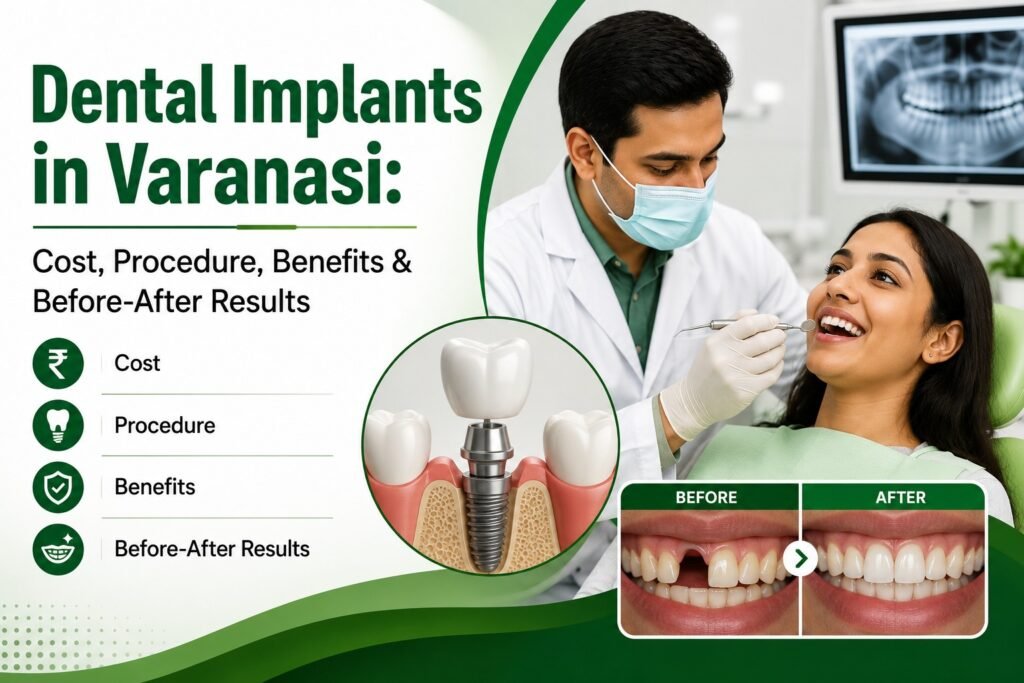
Dental Implants in Varanasi: Cost, Procedure, Benefits & Before-After Results
Medical note: Dental implants are a surgical treatment. The information below is educational and cannot replace an examination, X-rays/CBCT assessment, or an individualized treatment plan from a qualified dental professional.
Losing a tooth can change more than the way a smile looks. A missing tooth may make chewing uncomfortable, affect speech, alter the way neighboring teeth contact each other, and influence confidence in everyday situations.
For someone searching for dental implants in Varanasi, the first questions are usually practical: How much does a dental implant cost? Is the procedure painful? How long does it take? Will the result look natural? Is an implant better than a bridge or denture?
The answer depends on the patient’s bone, gums, medical history, number of missing teeth, implant system, restoration material, and treatment plan. Dental implants are not simply a “screw and crown” procedure; successful treatment requires diagnosis, surgical planning, healing, restoration, and long-term maintenance.
At Cherian Clinic in Varanasi, dental implant treatment can be planned around the patient’s individual oral-health condition rather than using a one-size-fits-all approach.
What Are Dental Implants?
Quick answer: A dental implant is an artificial tooth root, commonly made from titanium, that is placed into the jawbone to support a crown, bridge, or denture. It replaces the root portion of a missing tooth and provides a stable foundation for a replacement tooth. (Cambridge University Hospitals)
A conventional implant-supported tooth generally has three components:
- Implant fixture – placed into the jawbone.
- Abutment – connects the implant to the restoration.
- Dental crown – the visible tooth-shaped restoration.
The implant must integrate with the surrounding bone, a biological process known as osseointegration. Once adequately healed and restored, an implant can provide stable chewing function and a natural-looking appearance.
Why does this matter?
A bridge can replace a missing tooth by using neighboring teeth for support. A conventional denture rests on the gums. An implant, by contrast, is anchored within the jawbone.
That difference is one reason implants are frequently considered when a patient wants a fixed tooth replacement while preserving healthy adjacent teeth where clinically appropriate.
Who Is a Good Candidate for Dental Implants?
Quick answer: A suitable candidate generally needs adequate bone or a realistic pathway to adequate bone, healthy or treatable gums, acceptable oral hygiene, and a medical condition that allows predictable healing. Smoking, uncontrolled diabetes, active gum disease and some medications can increase risk.
Being suitable for implants is not determined by age alone.
During an implant consultation, a dentist may assess:
- Number and location of missing teeth
- Jawbone quantity and quality
- Gum health
- Existing infection or decay
- Bite and chewing forces
- Smoking or tobacco use
- Diabetes and other medical conditions
- Current medications
- Oral hygiene
- Expectations and cosmetic goals
Example: A patient missing one tooth but with healthy neighboring teeth and sufficient bone may be considered for a single implant. Another patient with advanced gum disease may first need periodontal treatment before implant placement is considered.
Practical tip: Do not select an implant clinic based only on an advertised price. Ask whether your examination, imaging, implant fixture, abutment, crown and follow-up care are included in the quotation.
Dental Implant Procedure: Step-by-Step
Quick answer: Implant treatment usually involves assessment and planning, implant placement, a healing period, attachment of the abutment, and placement of the final crown, bridge or denture. The exact sequence varies according to bone condition, infection, implant position and the type of restoration required.
Step 1: Consultation and examination
The dentist evaluates the missing tooth area, gums, bite and general oral health.
Step 2: Diagnostic imaging
Depending on the case, dental X-rays or three-dimensional imaging such as CBCT may be recommended to evaluate bone and important anatomical structures.
Step 3: Treatment planning
The dentist determines:
- Implant position
- Implant dimensions
- Restoration design
- Whether extraction is required
- Whether bone augmentation is needed
- Expected treatment sequence
Step 4: Implant placement
Under appropriate anesthesia, the implant is placed into the prepared jawbone.
Step 5: Healing and integration
The implant requires time to integrate with the bone. Healing time varies between individuals and procedures.
Step 6: Abutment and restoration
Once the implant is sufficiently stable, the abutment and final crown, bridge or denture can be fitted.
Treatment can therefore require several visits and, in some cases, several months from beginning to final restoration.
How Much Do Dental Implants Cost in Varanasi?
Quick answer: There is no single fixed price for dental implants in Varanasi. Published local estimates vary substantially depending on implant brand, crown material, number of teeth, bone condition, imaging, surgical complexity and additional procedures. A personalized quotation should be provided after clinical assessment.
A recent Varanasi dental-treatment listing reports implant prices beginning around ₹19,705, while another Varanasi-focused source reports approximately ₹20,000–₹60,000 depending on the treatment. These are market references, not a universal price or a quotation from Cherian Clinic.
What can influence the final cost?
| Cost factor | Why it matters |
|---|---|
| Implant brand | Different implant systems have different component costs |
| Crown material | Zirconia, ceramic and other options vary in price |
| Number of implants | Multiple missing teeth require a different treatment design |
| Bone grafting | Additional bone procedures may be required |
| Sinus augmentation | May be considered in selected upper-jaw cases |
| Imaging | 3D imaging may be required for complex planning |
| Surgical complexity | Difficult anatomy can require additional planning |
| Temporary teeth | Temporary restorations may add to the treatment cost |
| Follow-up | Maintenance and review should be considered |
Best practice: Ask for an itemized dental implant treatment estimate rather than comparing two headline prices. One clinic may quote only the implant fixture, while another may include the abutment, crown, imaging and follow-up.
Dental Implants vs Bridge vs Denture
Quick answer: Dental implants, bridges and dentures can all replace missing teeth, but they differ in how they are supported, treatment time, maintenance, cost and suitability. An implant may avoid preparation of adjacent healthy teeth, while a bridge can be faster and a denture can be a less invasive option.
| Feature | Dental Implant | Dental Bridge | Denture |
|---|---|---|---|
| Support | Jawbone | Neighboring teeth/implants | Gums and/or implants |
| Fixed option | Yes | Yes | Usually removable |
| Adjacent tooth preparation | Usually not required | Often required | Usually not |
| Surgery | Required | Usually no implant surgery | Usually no surgery |
| Treatment time | Often longer | Usually shorter | Variable |
| Bone preservation | Can help preserve bone | Does not replace root | Does not replace root |
| Maintenance | Excellent hygiene required | Good hygiene required | Cleaning and periodic adjustment |
| Cost | Usually higher initially | Often lower initially | Often lower initially |
There is no universally “best” option. The right treatment depends on the patient’s anatomy, oral health, expectations, finances and long-term goals.
What Are the Benefits of Dental Implants?
Quick answer: Dental implants can restore chewing function, improve smile appearance, provide stable support for replacement teeth and help preserve the jawbone around the missing-tooth area. They can also replace a single tooth without relying on adjacent healthy teeth for support.
Potential benefits include:
- Stable tooth replacement
- Improved chewing ability
- Natural-looking restoration
- Improved speech in suitable cases
- Support for bridges or dentures
- Avoidance of drilling healthy adjacent teeth in many single-tooth cases
- Maintenance of bone at the implant site compared with leaving the root absent
However, benefits depend on successful treatment and long-term maintenance.
An implant is not maintenance-free. The surrounding tissues can develop inflammation, and the crown or other prosthetic components can wear or require replacement over time.
Are Dental Implants Painful?
Quick answer: Implant placement is performed with anesthesia, so significant pain during the procedure is generally avoided. After surgery, patients may experience soreness, swelling or discomfort, with intensity varying according to the procedure and individual healing response.
The recovery experience can depend on:
- Number of implants
- Surgical complexity
- Bone grafting
- Individual healing
- Existing infection or inflammation
- Postoperative care
Your dental team should provide specific instructions for medication, food, oral hygiene and activity after surgery.
If severe or increasing pain, persistent swelling, fever, pus or implant mobility develops, contact the treating dental professional promptly.
Dental Implant Before-and-After Results: What Should You Expect?
Quick answer: Before-and-after implant results should be evaluated for both function and appearance. A successful outcome is not simply a whiter or straighter tooth; the replacement should be planned to fit the patient’s bite, gum contour, facial appearance and surrounding teeth. Individual results vary.
A properly planned implant restoration aims to achieve:
Before
- Missing tooth
- Difficulty chewing
- Visible gap
- Reduced confidence
- Possible movement of neighboring teeth
After
- Fixed replacement tooth
- Improved chewing function
- Improved smile appearance
- Better tooth-to-tooth contact
- More natural-looking dental proportions
Before-and-after photographs should be viewed carefully. Lighting, camera angle, tooth shade, gum position and editing can influence appearance.
For ethical treatment planning, patients should ask whether photographs represent actual clinical cases, whether consent was obtained, and whether the case is comparable to their own condition.
How Long Do Dental Implants Last?
Quick answer: Dental implants can have high long-term survival, but they are not guaranteed to last forever. Research has reported high 10-year implant survival, while long-term outcomes vary according to patient health, implant location, maintenance, smoking, gum health and other factors.
A systematic review of contemporary implant studies estimated approximately 96.4% implant-level survival at 10 years in its traditional analysis, although a sensitivity analysis produced a lower estimate of 93.2%.
Another systematic review of studies with at least 10 years of follow-up reported a cumulative mean implant survival of 94.6%.
These statistics describe groups of patients, not an individual’s guaranteed outcome.
What improves long-term maintenance?
- Brush regularly with appropriate technique
- Clean around the implant carefully
- Maintain healthy gums
- Avoid smoking and tobacco
- Attend recommended dental reviews
- Manage systemic conditions appropriately
- Address grinding or excessive bite forces when advised
Long-term professional maintenance is an important part of implant care.
What Can Cause Dental Implant Failure?
Quick answer: Implant failure can occur when an implant does not integrate properly with bone or when biological or mechanical complications develop later. Smoking, poor oral hygiene, gum disease, uncontrolled diabetes, excessive loading and some medical factors can increase risk.
Potential complications include:
- Failure of bone integration
- Infection around the implant
- Peri-implant inflammation
- Bone loss
- Implant loosening
- Crown or bridge damage
- Mechanical component problems
- Nerve or sinus-related complications in selected surgical situations
This is why implant dentistry should be approached as a complete treatment pathway rather than a single surgical appointment.
Practical tip: Before treatment, ask your dentist: “What are the risks in my specific case, and what can I do to reduce them?”
Why Choose Cherian Clinic for Dental Implants in Varanasi?
Quick answer: Patients considering dental implants should look for qualified dental professionals, individualized diagnosis, transparent treatment planning, appropriate imaging, infection-control practices and structured follow-up rather than choosing a clinic solely because of price.
At Cherian Clinic, Varanasi, patients can discuss tooth replacement options as part of personalized dental care.
Important factors to evaluate include:
- Clinical examination before treatment
- Appropriate diagnostic imaging
- Individualized implant planning
- Discussion of alternative treatments
- Clear explanation of costs
- Explanation of expected treatment stages
- Follow-up and maintenance planning
- Patient comfort and communication
What should patients compare?
Instead of asking only “Which is the cheapest dental implant in Varanasi?”, consider:
- Who will perform the procedure?
- What qualifications and implant training do they have?
- Which implant system is being proposed?
- Is the crown included?
- Is the abutment included?
- Is CBCT or other imaging required?
- Is bone grafting needed?
- What happens if healing is delayed?
- What follow-up is provided?
- What maintenance will be required?
This approach helps patients compare value and clinical planning, not just advertised price.
Dental Implant Care After Treatment
Quick answer: Dental implants require regular home care and professional maintenance. Cleaning around the implant helps control plaque and inflammation, while periodic dental examinations allow the health of the gums, bone and restoration to be monitored.
Daily care may include:
- Brushing twice daily
- Cleaning between teeth and around implants
- Following the dentist’s recommended cleaning method
- Avoiding tobacco
- Maintaining a balanced diet
- Wearing a night guard if prescribed for grinding
- Attending scheduled reviews
The exact cleaning routine should be customized to the implant design and patient’s oral condition.
Dental Implants in Varanasi: Frequently Asked Questions
1. How much do dental implants cost in Varanasi?
Dental implant prices in Varanasi vary according to implant brand, crown material, number of implants, bone condition, imaging and additional procedures. Published local estimates vary widely, so patients should request an itemized treatment estimate after examination.
2. Is a dental implant better than a bridge?
Not automatically. An implant may replace a missing tooth without preparing adjacent healthy teeth, while a bridge may require less surgical treatment and can sometimes be completed sooner. The appropriate option depends on your oral health and treatment goals.
3. How long does a dental implant procedure take?
The surgical placement itself may be completed in a relatively short appointment, but the overall treatment takes longer because the implant needs to heal and integrate with the jawbone before final restoration in many cases.
4. Are dental implants painful?
The procedure is performed under appropriate anesthesia. Some soreness, swelling or discomfort can occur afterward. Your dentist will provide individualized postoperative instructions.
5. Can smokers get dental implants?
Smoking can reduce implant predictability and increase the risk of complications. Dental teams generally recommend stopping smoking before and after implant treatment.
6. Can I get an implant if I have bone loss?
Possibly. Some patients with insufficient bone may require additional procedures such as bone augmentation before or alongside implant treatment. A clinical and radiographic assessment is necessary.
7. How long do dental implants last?
Dental implants can provide long-term function, with systematic reviews reporting high survival at 10 years. However, longevity varies and depends heavily on oral hygiene, gum health, smoking, bite forces and professional maintenance.
8. Do dental implants look natural?
A properly planned implant crown can be designed to match surrounding teeth in shape, shade and proportion. The final appearance depends on tooth position, gum contours, restoration design and individual anatomy.
9. Are dental implants suitable for older adults?
Age alone does not automatically exclude someone from implant treatment. Overall health, bone condition, gum health, oral hygiene, medications and ability to maintain the implant are more important factors.
10. Where can I get dental implants in Varanasi?
Patients looking for dental implants in Varanasi can consult a qualified dental professional for examination, imaging, treatment planning and discussion of suitable tooth-replacement options at Cherian Clinic
Final Takeaway
Dental implants in Varanasi can be a long-term tooth-replacement option for appropriately selected patients, but the right treatment is determined by clinical diagnosis—not by price alone.
The most important steps are a proper examination, evaluation of the gums and jawbone, appropriate imaging, transparent discussion of alternatives, an itemized treatment plan and long-term maintenance.
If you are considering an implant for a missing tooth, start with a consultation rather than choosing a treatment from an online price list. A well-planned implant should address function, health, appearance, comfort and long-term maintenance together.
At Cherian Clinic, Varanasi, patients can discuss their missing-tooth concerns and explore personalized dental replacement options based on their individual oral-health needs.

![# Root Canal Treatment in Varanasi: Cost, Procedure, Benefits & Recovery Guide **SEO Title:** Root Canal Treatment in Varanasi: Cost, Procedure, Benefits & Recovery Guide | Cherian Clinic **Meta Description:** Learn about root canal treatment in Varanasi, including symptoms, procedure, cost factors, benefits, recovery, crowns, alternatives and FAQs from Cherian Clinic. **Primary Keyword:** Root Canal Treatment in Varanasi **Search Intent:** Informational + Commercial + Local + Transactional > **Medical note:** This guide is for patient education and does not replace an examination or diagnosis by a qualified dental professional. Root canal treatment is recommended only when clinical findings support the diagnosis. ## Introduction: When Tooth Pain Changes Your Daily Life A toothache can begin as something easy to ignore: sensitivity while drinking tea, discomfort when chewing, or a dull pain that comes and goes. Then one night, the pain becomes strong enough to interrupt sleep. Many patients ask the same question: **“Can the tooth be saved, or will it have to be removed?”** In many cases, root canal treatment is designed specifically to **save a natural tooth when the pulp inside it becomes inflamed or infected**. The procedure removes the damaged pulp, cleans and disinfects the internal root canal system, seals it, and then restores the tooth so it can function again. ([American Association of Endodontists][1]) For patients searching for **root canal treatment in Varanasi**, the important decision is not simply finding the lowest price. Diagnosis, treatment planning, clinical expertise, infection control, restoration quality and appropriate follow-up all matter. At **Cherian Clinic, Sundarpur, Varanasi**, root canal treatment is listed among its dental services. The clinic states that its dental care approach combines experienced professionals, modern technology and personalized treatment planning. ([cherianclinic.com][2]) --- ## What Is Root Canal Treatment? ### Quick Answer **Root canal treatment is a procedure used to treat a tooth when the pulp inside it becomes inflamed or infected.** The dentist removes the affected pulp, cleans and disinfects the canals, fills and seals them, and then restores the tooth. The primary goal is to control infection and preserve the natural tooth whenever possible. ([American Association of Endodontists][1]) The inside of a mature tooth contains pulp, which includes nerves, blood vessels and connective tissue. Deep decay, cracks, repeated dental procedures or trauma can damage this tissue. If the inflammation or infection is not appropriately treated, it may progress to an abscess or cause increasing pain and swelling. ([American Association of Endodontists][3]) A root canal does **not** mean that the entire tooth is removed. Instead, the diseased tissue inside the tooth is treated while the natural tooth structure is retained. **Practical tip:** Do not assume every toothache requires a root canal. A dentist needs to examine the tooth and determine the actual cause. --- # 1. When Do You Need a Root Canal? ### Quick Answer A root canal may be recommended when the dental pulp is irreversibly inflamed or infected. Common warning signs include lingering sensitivity to hot or cold, pain while biting, swelling, tenderness, deep decay, cracks or changes in tooth colour. However, symptoms vary, and some infected teeth may produce little or no pain. ([American Association of Endodontists][3]) ### Common symptoms include: * Severe or persistent toothache * Pain while chewing or biting * Lingering sensitivity to hot or cold * Swollen or tender gums * A pimple or draining area on the gum * Deep dental decay * A cracked or chipped tooth * Darkening of a tooth * Previous extensive dental treatment on the same tooth Not every symptom automatically means you need root canal treatment. For example, tooth sensitivity can have several causes, including exposed dentin, gum recession or other dental conditions. **Example:** A patient with deep decay may initially experience sensitivity to cold. If the decay progresses toward the pulp, the symptoms can become more persistent and painful. **Practical tip:** If tooth pain lasts, repeatedly returns, or is accompanied by swelling, arrange a dental examination instead of relying only on painkillers. --- # 2. Why Does a Tooth Need Root Canal Treatment? ### Quick Answer The most common reasons for root canal treatment include **deep tooth decay, cracks or chips, repeated dental procedures and dental trauma**. These problems can allow bacteria or inflammation to affect the pulp. If the pulp cannot recover, treatment may be required to remove the diseased tissue and preserve the tooth. ([American Association of Endodontists][4]) The process can happen gradually. For example: **Cavity → deeper decay → pulp irritation → inflammation/infection → pain or abscess** However, this is not the only pathway. A traumatic injury can damage the pulp even when there is no obvious visible crack. Professional diagnosis therefore matters. **Expert insight:** Treating the underlying dental problem is different from temporarily controlling symptoms. Pain relief may make you feel better, but it does not necessarily eliminate the source of an infection. **Practical tip:** Do not wait for severe pain before seeking professional evaluation. --- # 3. How Is Root Canal Treatment Performed Step by Step? ### Quick Answer Root canal treatment generally involves examination and diagnosis, local anaesthesia, access to the tooth, removal of infected or inflamed pulp, cleaning and shaping of the canals, filling and sealing the canal space, and finally restoring the tooth. The exact sequence and number of appointments depend on the tooth and its condition. ([American Association of Endodontists][1]) ### Step 1: Examination and Diagnosis The dentist evaluates your symptoms and examines the tooth. Dental imaging may be used when clinically appropriate to assess the tooth and surrounding structures. ### Step 2: Local Anaesthesia Local anaesthesia is generally used so the patient remains awake but the treatment area is numbed. ([nhs.uk][5]) ### Step 3: Accessing the Tooth A small opening is made to reach the pulp chamber and root canals. ### Step 4: Removing the Diseased Pulp The damaged or infected pulp is removed. ### Step 5: Cleaning and Shaping The canals are carefully cleaned, disinfected and shaped to prepare them for sealing. ### Step 6: Filling and Sealing The cleaned canal system is filled and sealed to reduce the risk of reinfection. A commonly used filling material is gutta-percha. ([American Association of Endodontists][6]) ### Step 7: Final Restoration The tooth may require a permanent filling or crown depending on its structural condition. **Practical tip:** Completing the recommended final restoration is an important part of protecting a treated tooth. --- # 4. Is Root Canal Treatment Painful? ### Quick Answer Modern root canal treatment is performed with local anaesthesia and is generally designed to be comfortable. Some patients may experience tenderness or mild discomfort after treatment as the surrounding tissues recover. The experience can vary depending on the tooth, infection and individual sensitivity. ([American Association of Endodontists][6]) The fear surrounding root canals is often greater than the procedure itself. The American Association of Endodontists notes that modern anaesthesia and techniques make root canal treatment highly comfortable for most patients. ([American Association of Endodontists][6]) After treatment, some soreness can occur. This does not necessarily mean the treatment has failed. **Example:** A tooth with significant inflammation may remain tender for a short period even after the infected pulp has been removed. **Practical tip:** Tell your dentist about dental anxiety, previous difficult dental experiences or pain concerns before treatment. Communication can help the clinical team plan a more comfortable experience. --- # 5. How Many Appointments Does Root Canal Treatment Take? ### Quick Answer The number of appointments is **case-dependent**. Some root canal treatments can be completed efficiently in one appointment, while others require two or more visits because of infection, tooth anatomy, treatment complexity or the need for an interim restoration. There is no single appointment schedule suitable for every patient. ([American Association of Endodontists][1]) The number of canals, infection status, tooth location and complexity can influence treatment time. Cherian Clinic promotes root canal treatment among its dental services and describes its approach as using personalized treatment planning. ([cherianclinic.com][2]) A complicated molar should not be rushed simply to meet a one-visit target. **Practical tip:** Ask your dentist: 1. How many visits are expected? 2. What is the condition of the tooth? 3. Will a crown be required? 4. What happens if additional infection is found? 5. What is included in the quoted treatment cost? --- # 6. Root Canal Treatment Cost in Varanasi: What Determines the Price? ### Quick Answer The **cost of root canal treatment in Varanasi varies from patient to patient**. Factors can include the tooth involved, number of canals, infection severity, diagnostic requirements, treatment complexity, materials, restoration type and whether additional procedures are necessary. A reliable price should be provided after clinical assessment rather than guessed from symptoms alone. ### Major cost factors | Factor | Why it matters | | --------------------- | ------------------------------------------------------ | | Type of tooth | Front teeth and molars have different anatomy | | Number of canals | More complex canal systems can require additional work | | Infection | Infection may affect treatment planning | | Imaging | Diagnostic imaging may be clinically necessary | | Restoration | A filling or crown may be required after RCT | | Retreatment | Previously treated teeth can be more complex | | Additional procedures | Some cases require further treatment | A common mistake is comparing only the **root canal fee**. The complete treatment may include consultation, diagnostic imaging, root canal therapy and the final restoration. Therefore, patients searching for **“root canal treatment cost near me”** or **“RCT cost in Varanasi”** should ask for a treatment-wise estimate. **At Cherian Clinic:** Patients can contact the clinic in Sundarpur, Varanasi, for an assessment and treatment plan. The clinic lists its contact number as **+91-8130014544**. ([cherianclinic.com][7]) **Practical tip:** Choose transparency over an artificially low headline price. Ask what the quoted amount includes. --- # 7. Root Canal vs Tooth Extraction: Which Is Better? ### Quick Answer When a natural tooth can be predictably restored, root canal treatment may offer the advantage of preserving the tooth rather than removing it. Extraction may be necessary when a tooth cannot be predictably saved because of factors such as severe structural damage. The appropriate choice depends on examination and prognosis. ([American Association of Endodontists][6]) | Root Canal | Extraction | | ---------------------------------------------- | -------------------------------------------- | | Attempts to preserve natural tooth | Removes the natural tooth | | Maintains natural tooth structure | Creates a missing-tooth space | | Usually followed by restoration | May require implant, bridge or denture | | Can preserve normal chewing function | Replacement may require additional treatment | | Requires appropriate remaining tooth structure | May be necessary when tooth cannot be saved | The American Association of Endodontists emphasizes that saving the natural tooth can help maintain normal chewing and reduce the need for additional dental work. ([American Association of Endodontists][6]) However, **root canal treatment is not always the correct choice**. A dentist should explain whether the tooth is restorable and discuss alternatives when appropriate. **Practical tip:** Ask, “Is my tooth predictably restorable, and what are the alternatives?” before deciding on extraction. --- # 8. Why Is a Crown Sometimes Needed After Root Canal Treatment? ### Quick Answer A tooth that has undergone root canal treatment may need a crown or another appropriate restoration to protect it, particularly when substantial tooth structure has been lost. The final restoration depends on the tooth's location, remaining structure, biting forces and clinical assessment. ([American Association of Endodontists][1]) The root canal treats the inside of the tooth, but the tooth still needs structural protection. Posterior teeth such as premolars and molars experience significant chewing forces. If a large amount of tooth structure has been lost, a dentist may recommend a crown. ### Treatment sequence may therefore be: **Diagnosis → Root canal → Temporary/permanent restoration → Final crown when indicated → Follow-up** **Example:** A molar with extensive decay may require both root canal therapy and a crown to restore function and protect the remaining tooth structure. **Practical tip:** Do not treat the crown as an optional cosmetic add-on without asking why it has been recommended. Its role may be functional protection. --- # 9. What Is Recovery Like After a Root Canal? ### Quick Answer Most patients can return to normal activities relatively quickly, although the treated tooth may feel tender or the mouth may remain numb for several hours after local anaesthesia. Follow your dentist's instructions, attend scheduled follow-ups and avoid putting unnecessary stress on a tooth awaiting its final restoration. ([American Association of Endodontists][1]) ### After-treatment guidance * Wait until numbness has worn off before eating. * Follow the dentist's medication instructions. * Avoid biting hard foods on a temporarily restored tooth. * Maintain normal oral hygiene unless your dentist advises otherwise. * Attend the recommended follow-up. * Complete the final restoration when advised. The NHS notes that soreness or swelling around the tooth may occur and should generally improve; persistent or worsening symptoms require professional review. ([nhs.uk][5]) **When should you contact your dentist?** Contact your dental provider if you develop significant swelling, worsening pain, fever, difficulty swallowing or other concerning symptoms. **Practical tip:** Do not ignore a temporary filling or postpone the final restoration indefinitely. --- # 10. Can Root Canal Treatment Save a Natural Tooth? ### Quick Answer Yes. One of the central purposes of root canal treatment is to **save a natural tooth that might otherwise require extraction**. After the infected pulp is removed and the canal is cleaned, disinfected and sealed, the tooth can be restored and continue functioning. With appropriate care, many treated teeth can remain functional for many years. ([American Association of Endodontists][6]) Keeping a natural tooth can provide practical advantages: * Natural appearance * Normal chewing * Natural tooth position * Reduced need for tooth replacement * Preservation of surrounding structures But success depends on more than the root canal itself. The tooth needs adequate remaining structure, appropriate treatment, a good final restoration and ongoing oral hygiene. **Practical tip:** Think of root canal treatment as part of a larger tooth-saving plan rather than an isolated procedure. --- # 11. What Makes a Good Root Canal Treatment Clinic in Varanasi? ### Quick Answer A suitable root canal provider should offer accurate diagnosis, clear treatment planning, appropriate technology, infection-control practices, transparent communication and suitable restorative follow-up. Patients should also consider the clinician's qualifications and experience rather than choosing a clinic solely because it advertises the lowest RCT price. For patients comparing a **root canal dentist in Varanasi**, consider: ### 1. Clinical qualifications Check the dentist's professional education, registration and relevant experience. ### 2. Diagnostic capability A proper diagnosis should come before treatment. ### 3. Modern clinical equipment Appropriate dental technology can support diagnosis and treatment, although technology should complement—not replace—professional clinical judgment. ### 4. Sterilization and hygiene Dental instruments and treatment environments should follow appropriate infection-control protocols. ### 5. Transparent communication The dentist should explain: * Diagnosis * Treatment options * Expected appointments * Restoration requirements * Risks and limitations * Estimated costs ### 6. Patient experience Reviews can provide useful information about communication, comfort and service—but they should not replace professional evaluation. Cherian Clinic identifies itself as a dental, skin and hair care centre in **Sundarpur, Varanasi, Uttar Pradesh**, and its website currently displays patient-review information and describes personalized dental treatment. ([cherianclinic.com][2]) **Practical tip:** Compare clinics on clinical quality and transparency—not just price. --- # 12. Why Choose Cherian Clinic for Root Canal Treatment in Varanasi? ### Quick Answer Cherian Clinic is a multi-specialty dental, skin and hair care clinic located in Sundarpur, Varanasi. Its website lists root canal treatment among its dental services and highlights personalized treatment planning, modern technology and experienced dental care. Patients can contact the clinic for an examination to determine whether root canal treatment is appropriate. ([cherianclinic.com][2]) ### Clinical leadership Cherian Clinic identifies **Dr. Navneet Kaur** as its Director and describes her as having more than 15 years of professional experience. Her qualifications and professional background include a **Bachelor of Dental Surgery (BDS)** and training in dental implantology and facial aesthetics, based on the professional information provided by the clinic. Her experience includes clinical leadership, patient-care systems, treatment protocols and dental practice management. ### Patient-focused approach The clinic emphasizes: * Personalized treatment planning * Modern dental technology * Patient communication * Comfortable clinical care * Dental treatment for different age groups * Preventive and restorative services The clinic's website currently reports **4.9 average rating, 200+ reviews and 5K+ patients treated**; these are clinic-reported figures and may change over time. ([cherianclinic.com][2]) **Trust principle:** A review score can help patients compare experiences, but treatment decisions should always be based on individual clinical assessment. --- # Root Canal Treatment in Varanasi: Patient Decision Checklist Before booking treatment, ask these questions: ### Diagnosis * What is causing my tooth pain? * Is the pulp infected or inflamed? * Is root canal treatment definitely indicated? * Is the tooth restorable? ### Treatment * How many appointments may be needed? * What technology will be used? * Will I need a temporary filling? * Will I need a crown? ### Cost * What is included in the quoted cost? * Are X-rays included? * Is the final crown included? * Could additional treatment be required? ### Recovery * How long should sensitivity last? * What should I avoid eating? * When should I return? * What symptoms require urgent review? These questions make the consultation more useful and help patients make informed decisions. --- # Root Canal Treatment: Pros and Cons | Advantages | Considerations | | -------------------------------- | ------------------------------------- | | Can preserve a natural tooth | Requires professional diagnosis | | Treats infected pulp | May require more than one appointment | | Can restore chewing function | Final restoration may be necessary | | Avoids immediate extraction | Complex cases can be challenging | | Maintains natural tooth position | Treatment cost varies by case | The goal is not simply to complete a procedure. The goal is to achieve a healthy, functional and appropriately restored tooth. --- # Frequently Asked Questions About Root Canal Treatment in Varanasi ## 1. How much does root canal treatment cost in Varanasi? There is no single price that applies to every patient. Cost depends on the tooth, number of canals, complexity, infection, diagnostic requirements and final restoration. A dental examination is the best way to receive a case-specific estimate. ## 2. Is root canal treatment painful? Modern root canal treatment is performed using local anaesthesia and is generally designed to be comfortable. Mild tenderness after treatment can occur and usually improves as the tissues recover. ([American Association of Endodontists][6]) ## 3. How long does root canal treatment take? Treatment time varies. Some cases can be completed efficiently in one visit, while others require multiple appointments depending on infection, tooth anatomy and complexity. ([nhs.uk][5]) ## 4. Do I need a crown after root canal treatment? A crown may be recommended when substantial tooth structure has been lost or when additional protection is appropriate. The need depends on the tooth and its remaining structure. ## 5. Can a root canal fail? Root canal treatment can sometimes require retreatment or additional procedures. Persistent infection, complex anatomy, cracks or problems with the restoration can contribute to treatment difficulties. ## 6. Is extraction better than root canal treatment? Not necessarily. When a tooth is predictably restorable, preserving it may offer important functional benefits. Extraction may be recommended when the tooth cannot be predictably saved. ([American Association of Endodontists][8]) ## 7. Can I eat normally after a root canal? Follow your dentist's instructions. If the area is still numb, wait until sensation returns before eating. Avoid putting excessive force on a tooth that has a temporary restoration. ## 8. Can a tooth need a root canal without severe pain? Yes. Pulp damage or infection does not always cause severe symptoms. A dental examination is necessary when there are persistent concerns. ## 9. Where can I get root canal treatment in Varanasi? Cherian Clinic provides dental care in **Sundarpur, Varanasi, Uttar Pradesh**, and lists root canal treatment among its dental services. ([cherianclinic.com][2]) ## 10. How do I book a root canal consultation at Cherian Clinic? Patients can contact Cherian Clinic at **+91-8130014544** or visit its Sundarpur, Varanasi location for a dental consultation. ([cherianclinic.com][7]) --- # Internal Linking Recommendations for Cherian Clinic For stronger topical authority and user navigation, link this article naturally to: * **Dental Treatment in Varanasi** — anchor: *dental treatments in Varanasi* * **Dental Checkup in Varanasi** — anchor: *dental checkup in Varanasi* * **Teeth Cleaning & Scaling** — anchor: *professional teeth cleaning* * **Dental Implants in Varanasi** — anchor: *dental implants in Varanasi* * **Dental Crowns & Bridges** — anchor: *dental crowns after root canal* * **Emergency Dental Care** — anchor: *emergency dentist in Varanasi* * **Why Regular Dental Checkups Are Important** — anchor: *importance of regular dental checkups* Cherian Clinic's website currently provides location-specific dental service pages, including root canal treatment pages for areas such as Sundarpur, Bhelupur, Lanka, Durgakund, Mahmoorganj and Sigra. ([cherianclinic.com][2]) --- # Recommended Schema Markup For this article, the strongest structured-data combination would be: 1. **Article Schema** — identifies the article and author. 2. **Person Schema** — for Dr. Navneet Kaur, using only verified professional information. 3. **LocalBusiness/Dentist Schema** — for Cherian Clinic's physical location. 4. **Breadcrumb Schema** — improves site hierarchy. 5. **FAQPage Schema** — only when the visible FAQ content is actually present on the page. 6. **Review/AggregateRating Schema** — use carefully and only when the reviews and rating meet Google's structured-data requirements and are genuinely displayed on the page. Avoid adding schema simply to increase the number of markup types. Structured data should accurately represent visible, verifiable information. --- # AI Search & AEO Optimization Checklist This article is structured to provide clear answers for: * **“What is root canal treatment?”** * **“When do I need an RCT?”** * **“Is root canal painful?”** * **“How long does RCT take?”** * **“What is root canal treatment cost in Varanasi?”** * **“RCT vs extraction?”** * **“Do I need a crown after RCT?”** * **“How long is root canal recovery?”** * **“Where can I get root canal treatment near me?”** * **“How do I choose a root canal dentist in Varanasi?”** The content uses direct definitions, step-by-step treatment information, comparison tables, cost factors, local information, professional context, FAQs and transparent limitations—formats that make information easier for both readers and answer-oriented search systems to understand. --- # Conclusion: Treat the Tooth, Not Just the Pain Root canal treatment is fundamentally about **saving and restoring a natural tooth when the pulp has become seriously inflamed or infected**. Modern techniques and local anaesthesia have made treatment substantially more comfortable than the outdated image many people associate with a “root canal.” ([American Association of Endodontists][6]) The most important step is early professional evaluation. Persistent tooth pain, lingering sensitivity, swelling or discomfort while chewing should not simply be ignored. For patients searching for **root canal treatment in Varanasi**, cost is one consideration—but it should not be the only one. Diagnosis, clinical experience, treatment planning, infection control, restoration quality, transparency and follow-up are equally important. **Cherian Clinic in Sundarpur, Varanasi** provides dental services including root canal treatment and offers consultations to help patients understand their treatment options. ([cherianclinic.com][2]) **A painful tooth does not always mean a lost tooth. In many cases, the right diagnosis and timely treatment can help preserve your natural smile.** **Author:** Dr. Navneet Kaur, BDS — Director, Cherian Clinic **Location:** N-13/35 A-12, Brij Enclave, Sundarpur, Varanasi, Uttar Pradesh, India **Consultation:** +91-8130014544 ([cherianclinic.com][7]) **Trusted references:** American Association of Endodontists patient education resources and NHS clinical guidance on root canal treatment. ([American Association of Endodontists][1]) **Official clinic information:** [Cherian Clinic](https://cherianclinic.com/?utm_source=chatgpt.com) [1]: https://www.aae.org/patients/root-canal-treatment/what-is-a-root-canal/?utm_source=chatgpt.com "What is a Root Canal? - American Association of Endodontists" [2]: https://cherianclinic.com/?utm_source=chatgpt.com "Best & No.1 Dentist Near Me in Varanasi | Top Dental Consultation ₹300 – Cherian Clinic" [3]: https://www.aae.org/patients/root-canal-treatment/what-is-a-root-canal/root-canal-explained/?utm_source=chatgpt.com "Root Canal Explained - American Association of Endodontists" [4]: https://www.aae.org/patients/root-canal-treatment/what-is-a-root-canal/reasons-root-canal-treatment/?utm_source=chatgpt.com "Reasons for Root Canal Treatment - American Association of Endodontists" [5]: https://www.nhs.uk/tests-and-treatments/root-canal-treatment/?utm_source=chatgpt.com "Root canal treatment" [6]: https://www.aae.org/patients/root-canal-treatment/what-is-a-root-canal/benefits-root-canal-treatment/?utm_source=chatgpt.com "Benefits of Root Canal Treatment - American Association of Endodontists" [7]: https://cherianclinic.com/contact/?utm_source=chatgpt.com "Contact - cherianclinic.com" [8]: https://www.aae.org/patients/root-canal-treatment/faqs/treatments-and-procedures/?utm_source=chatgpt.com "Treatments and Procedures - American Association of Endodontists"](https://cherianclinic.com/wp-content/uploads/2026/08/WhatsApp-Image-2026-08-06-at-6.22.18-PM-1-150x150.jpeg)