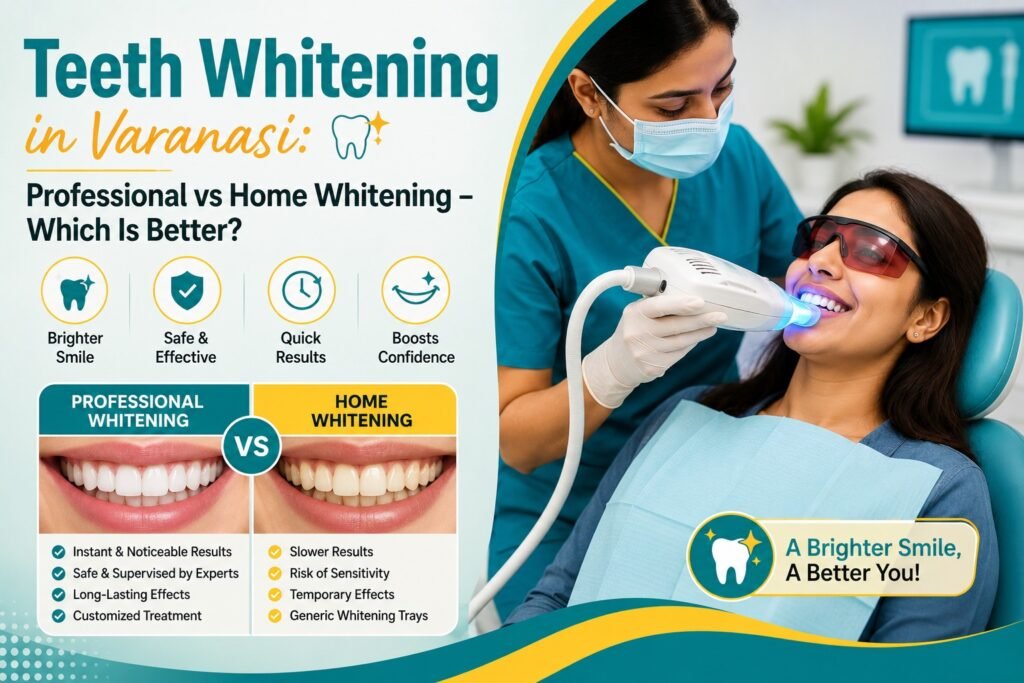
Teeth Whitening in Varanasi: Professional vs Home Whitening – Which Is Better?
A brighter smile can change more than the appearance of your teeth. It can make people feel more comfortable speaking, smiling in photographs, attending interviews, or meeting someone for the first time. But when someone searches for “teeth whitening in Varanasi,” one important question usually follows: Should I choose professional whitening at a dental clinic or try a home whitening product?
The answer depends on your teeth, the type of staining, your oral health, your sensitivity level, and how quickly you want results.
Professional teeth whitening can provide faster, dentist-controlled treatment, while dentist-supervised home whitening can offer gradual results with greater flexibility. Over-the-counter strips and whitening toothpastes may also help with certain surface stains, but they are not appropriate for every situation. The American Dental Association (ADA) notes that whitening options include in-office bleaching, dentist-supplied home products, and over-the-counter products.
At Cherian Clinic in Sundarpur, Varanasi, Uttar Pradesh, teeth whitening is offered as part of its cosmetic dental services. The clinic describes its approach as personalized and supported by modern dental technology.
Quick answer: Professional teeth whitening is generally the better choice when you want faster results, professional assessment, and controlled treatment. Home whitening can be suitable when gradual whitening is preferred, particularly when it is prescribed or supervised by a dentist.
1. What Is Teeth Whitening?
Quick Answer: Teeth whitening is a cosmetic dental treatment designed to lighten the natural colour of teeth and reduce certain types of discoloration. Whitening commonly uses peroxide-based agents, such as hydrogen peroxide or carbamide peroxide, to break down coloured compounds within the tooth.
Teeth can become darker for many reasons. Coffee, tea, tobacco, red wine, certain foods, ageing, and some medications can contribute to discoloration. Some stains are on the outer surface of the teeth, while others are deeper within the tooth.
The ADA explains that whitening can address both extrinsic and intrinsic staining, although the response depends on the cause and condition of the teeth.
Common causes of tooth discoloration
- Tea and coffee consumption
- Tobacco use
- Certain foods and beverages
- Natural ageing
- Enamel changes
- Previous dental trauma
- Certain medications
- Accumulated surface stains
Practical tip: If your teeth look yellow or stained, do not assume whitening is automatically the right solution. A dental examination can determine whether cleaning, whitening, restorative treatment, or another approach is more appropriate.
2. Professional Teeth Whitening vs Home Whitening: What Is the Difference?
Quick Answer: Professional whitening is performed or prescribed under dental supervision and can produce results more quickly. Home whitening generally takes longer and can include dentist-supervised custom trays or over-the-counter products such as strips and whitening toothpaste.
| Feature | Professional In-Office Whitening | Dentist-Supervised Home Whitening | OTC Home Whitening |
|---|---|---|---|
| Dental assessment | Yes | Yes | Usually no |
| Treatment supervision | Direct | Dentist-guided | Self-directed |
| Speed | Usually faster | Gradual | Gradual |
| Customization | High | High with custom trays | Limited |
| Convenience | Clinic visit required | Convenient at home | Highly convenient |
| Sensitivity management | Professional monitoring | Dentist guidance | Self-managed |
| Suitable for existing dental problems | Assessment required | Assessment required | May not detect problems |
| Cost | Usually higher | Often moderate | Usually lower |
| Best for | Faster cosmetic change | Controlled gradual whitening | Mild surface staining |
A systematic review published in 2025 found that different professional bleaching approaches can effectively change tooth colour, while outcomes and sensitivity can vary according to the treatment protocol. (PubMed)
The important point is that “home whitening” is not one single treatment. Dentist-supervised custom-tray whitening is different from purchasing an unregulated product online.
3. Which Is Better: Professional or Home Teeth Whitening?
Quick Answer: Neither option is universally better for every patient. Professional whitening is often preferable when speed, clinical assessment, and controlled application are priorities. Dentist-supervised home whitening may be preferable when gradual treatment and convenience matter more.
Professional whitening may be better when:
- You want faster cosmetic results.
- You have an important event approaching.
- Your dentist has confirmed that whitening is appropriate.
- You have concerns about sensitivity.
- You have complex or uneven staining.
- You want professional monitoring.
Home whitening may be better when:
- You prefer gradual whitening.
- You want to continue treatment at home.
- Your dentist recommends custom trays.
- You are comfortable following a treatment schedule.
- Convenience is important.
The ADA notes that professional in-office whitening can use higher concentrations of whitening chemicals and may produce whitening more quickly, while at-home options generally require regular use over a longer period.
Professional recommendation: The best method should be selected after evaluating the condition of your teeth and gums rather than choosing purely on price or speed.
4. How Does Professional Teeth Whitening Work?
Quick Answer: Professional teeth whitening begins with an assessment of your teeth and gums. The dentist identifies the cause of discoloration, checks for dental problems, discusses expectations, and then selects an appropriate whitening method.
A typical clinical pathway can include:
Step 1: Dental examination
The dentist checks for cavities, gum problems, cracks, sensitivity, restorations, and other concerns.
Step 2: Identify the type of staining
The dentist determines whether discoloration is mainly surface-related or deeper.
Step 3: Professional cleaning, if needed
Plaque, tartar, and surface stains may need to be removed before whitening. Professional cleaning can sometimes make teeth appear noticeably brighter by itself.
Step 4: Whitening planning
The dentist selects the appropriate whitening concentration and treatment method.
Step 5: Controlled application
Whitening material is applied carefully to reduce unnecessary contact with the gums.
Step 6: Monitoring
The dental team observes your comfort and the treatment response.
Step 7: Aftercare
You receive instructions to help maintain the result and manage temporary sensitivity if it occurs.
This structured process is one of the main advantages of professional teeth whitening over unsupervised treatment.
5. How Does Home Teeth Whitening Work?
Quick Answer: Home whitening uses a whitening product according to a specific schedule. Dentist-supervised home whitening may use custom-fitted trays and professional-strength gel, while OTC options include strips, gels, trays, and whitening toothpastes.
A dentist-supervised home whitening plan may involve:
- Dental examination
- Selection of the appropriate whitening method
- Custom tray preparation, where applicable
- Instructions on how much gel to use
- A recommended treatment schedule
- Monitoring and follow-up
- Adjustment if sensitivity occurs
OTC products work differently. Whitening toothpastes mainly help remove surface stains through abrasives, while many whitening strips rely on peroxide-based bleaching. (ADA)
Important distinction
Dentist-supervised home whitening ≠ random home remedy.
Lemon juice, baking soda mixtures, charcoal products, or unverified whitening chemicals should not be treated as equivalent alternatives to clinically planned whitening.
6. Is Teeth Whitening Safe?
Quick Answer: Teeth whitening is generally considered safe when appropriate products are used correctly and treatment is suitable for the individual. Temporary tooth sensitivity and gum irritation are among the most common side effects of peroxide-based whitening.
The ADA reports that temporary sensitivity and gingival irritation are common adverse effects of vital tooth whitening. Sensitivity can be influenced by factors such as peroxide concentration and exposure time.
That does not mean whitening is appropriate for everyone.
A dentist may need to evaluate:
- Existing cavities
- Gum disease
- Enamel defects
- Cracked teeth
- Severe sensitivity
- Dental restorations
- Uneven tooth colour
Unregulated whitening can also create risks. The ADA has warned about complications associated with unlicensed whitening services, including gum damage, increased sensitivity, irritation, and other problems.
Practical tip: If a whitening product causes significant pain, burning, gum irritation, or unusual sensitivity, stop using it and seek professional dental advice.
7. Can Whitening Remove Every Type of Stain?
Quick Answer: No. Teeth whitening works best on certain natural-tooth discolorations, but it cannot whiten every type of stain or dental restoration. Crowns, veneers, fillings, and other tooth-coloured restorations generally do not respond to bleaching in the same way natural teeth do.
This is particularly important for people who have:
- Dental crowns
- Veneers
- Tooth-coloured fillings
- Bridges
- Previously restored front teeth
The ADA specifically notes that only natural teeth can be whitened, not tooth-coloured restorations.
Example
Suppose someone has natural teeth that have darkened from years of tea and coffee but also has a front crown. Whitening may lighten the natural teeth while the crown remains the same shade.
That could create a colour mismatch.
This is why a professional assessment matters before cosmetic whitening.
8. Teeth Cleaning vs Teeth Whitening: Are They the Same?
Quick Answer: No. Teeth cleaning removes plaque, tartar, and surface deposits, while teeth whitening is a cosmetic procedure intended to lighten the colour of natural teeth.
| Teeth Cleaning | Teeth Whitening |
|---|---|
| Preventive dental care | Cosmetic dental treatment |
| Removes plaque and tartar | Lightens tooth colour |
| Helps manage surface stains | Targets tooth discoloration |
| Supports gum health | Improves smile brightness |
| Does not chemically bleach teeth | Usually uses peroxide-based agents |
Cherian Clinic explains that professional cleaning removes plaque and tartar and can remove surface stains, potentially making teeth look brighter. It also distinguishes cleaning from whitening.
Which should you choose?
If your teeth look dull because of tartar or surface deposits, cleaning may be the appropriate first step.
If your teeth are clean but naturally darker or discoloured, whitening may be considered after a dental assessment.
9. How Much Does Teeth Whitening Cost in Varanasi?
Quick Answer: The cost of teeth whitening in Varanasi depends on the treatment method, the patient’s dental condition, the whitening system used, and whether additional procedures such as cleaning or treatment of dental problems are required.
It is better to avoid choosing a clinic based only on the lowest advertised price.
Before starting treatment, ask:
- What whitening method is being recommended?
- Is a dental examination included?
- Is professional cleaning required first?
- Is the treatment performed by a qualified dental professional?
- What type of whitening material is being used?
- How many sessions are expected?
- What happens if sensitivity develops?
- Are follow-up appointments included?
For patients searching for affordable teeth whitening in Varanasi, transparent treatment planning is more useful than a headline price without clinical context.
Cherian Clinic lists its location as N-13/35 A-12, Brij Enclave, Sundarpur, Varanasi, Uttar Pradesh, with appointment contact information on its official website.
10. How Long Do Teeth Whitening Results Last?
Quick Answer: Whitening results are not permanent. Their longevity depends on the original cause of staining, diet, oral hygiene, tobacco use, ageing, and maintenance. Regular dental care and limiting staining habits can help maintain a brighter appearance.
Habits that may help maintain results
- Brush twice daily with fluoride toothpaste.
- Clean between teeth regularly.
- Attend recommended dental checkups.
- Limit frequent exposure to staining beverages.
- Avoid tobacco.
- Follow your dentist’s post-whitening instructions.
- Do not repeatedly bleach your teeth without professional guidance.
A useful way to think about whitening is as a cosmetic maintenance treatment, not a permanent change to tooth colour.
11. Who Is a Good Candidate for Teeth Whitening?
Quick Answer: Adults with healthy natural teeth and gums who have appropriate types of discoloration may be candidates for whitening. A dentist should first check oral health and identify the cause of staining before recommending treatment.
You may be a potential candidate if you have:
- Yellow or stained natural teeth
- Coffee or tea-related discoloration
- Age-related darkening
- Certain types of extrinsic stains
- Good oral health
- Realistic expectations
You may need dental treatment before whitening if you have:
- Untreated cavities
- Significant gum disease
- Severe tooth sensitivity
- Cracked teeth
- Certain enamel problems
- Extensive restorations on visible teeth
Children and adolescents require particular consideration, and cosmetic bleaching is not routinely appropriate for younger patients. The ADA notes that the American Academy of Pediatric Dentistry discourages full-arch cosmetic bleaching for children and adolescents in mixed or primary dentition.s
12. Why Choose Professional Teeth Whitening in Varanasi?
Quick Answer: Choosing professional teeth whitening in Varanasi allows patients to discuss their goals with a dental professional, identify oral health issues before whitening, select an appropriate treatment approach, and receive guidance about sensitivity and aftercare.
At Cherian Clinic, the dental department offers whitening as part of its cosmetic dental services. The clinic states that its approach combines modern technology, experienced dental professionals, and personalized treatment planning.
Cherian Clinic’s patient-focused approach
The clinic identifies Dr. Navneet Kaur as its Director for Dental, Skin & Hair services and states that she has more than 15 years of professional experience. Its website lists expertise including cosmetic dentistry and smile designing.
The clinic also displays patient-review information and describes a focus on personalized care and modern facilities.
For local patients, Cherian Clinic is located in Sundarpur, Varanasi, making it relevant for searches such as:
- Teeth whitening in Varanasi
- Professional teeth whitening near Sundarpur
- Cosmetic dentist in Varanasi
- Teeth whitening near me
- Smile designing in Varanasi
- Cosmetic dental treatment in Varanasi
Professional vs Home Whitening: Final Comparison
| Factor | Professional Whitening | Dentist-Supervised Home Whitening | OTC Whitening |
|---|---|---|---|
| Professional assessment | Yes | Yes | Usually no |
| Speed | Faster | Gradual | Gradual |
| Customization | High | High | Limited |
| Convenience | Moderate | High | High |
| Monitoring | Direct | Follow-up | None |
| Sensitivity guidance | Available | Available | Limited |
| Best use | Faster cosmetic change | Controlled home treatment | Mild surface stains |
| Main limitation | Requires clinic visit | Requires compliance | Less individualized |
The bottom line
There is no single whitening method that is best for every person.
Choose professional whitening when you value speed, clinical supervision, and individualized treatment. Choose dentist-supervised home whitening when you prefer gradual treatment and convenience. Choose OTC products carefully, particularly if you have sensitive teeth or existing dental problems.
The most important decision is not simply “clinic or home?” It is “Which method is appropriate for my teeth?”
Teeth Whitening in Varanasi: Frequently Asked Questions
Is professional teeth whitening better than home whitening?
Professional whitening is often preferable when faster results and professional assessment are priorities. Dentist-supervised home whitening can also be effective and more convenient. The appropriate choice depends on staining, oral health, sensitivity, restorations, and treatment goals.
Is teeth whitening painful?
Teeth whitening is generally well tolerated, but temporary sensitivity can occur. Gum irritation is also possible, particularly when whitening gel contacts the gums. A dentist can help select an appropriate protocol and manage sensitivity risk.
Can teeth cleaning whiten teeth?
Professional cleaning can remove plaque, tartar, and surface stains, making teeth appear cleaner and brighter. However, cleaning is not the same as bleaching and does not chemically lighten the natural tooth colour.
Can I whiten teeth with home remedies?
It is better not to rely on unverified home remedies or abrasive mixtures. Some may irritate gums or damage tooth surfaces. For a safer approach, discuss evidence-based whitening options with a qualified dentist.
Does teeth whitening work on crowns and veneers?
No. Whitening agents do not lighten crowns, veneers, fillings, or other tooth-coloured restorations in the same way they lighten natural teeth.
How long does teeth whitening take?
The timeframe depends on the selected treatment. In-office whitening is generally faster, while dentist-supervised and OTC home methods require repeated applications over a longer period.
Where can I get teeth whitening in Varanasi?
Patients can consult the dental team at Cherian Clinic in Sundarpur, Varanasi to discuss whitening and cosmetic dental treatment options. The clinic lists teeth whitening among its dental services.
Author & Clinical Perspective
Dr. Navneet Kaur
Director – Cherian Clinic | Dental, Skin & Hair
Cherian Clinic identifies Dr. Navneet Kaur as a dental professional with more than 15 years of experience and lists expertise in areas including cosmetic dentistry and smile designing. Her professional approach emphasizes clinical assessment, personalized treatment planning, and patient-focused care.
Clinical note: Teeth whitening is a cosmetic procedure, not a substitute for treating cavities, gum disease, cracked teeth, or other oral health conditions. A dental examination is particularly important if you have pain, sensitivity, bleeding gums, or existing dental restorations.

![# Root Canal Treatment in Varanasi: Cost, Procedure, Benefits & Recovery Guide **SEO Title:** Root Canal Treatment in Varanasi: Cost, Procedure, Benefits & Recovery Guide | Cherian Clinic **Meta Description:** Learn about root canal treatment in Varanasi, including symptoms, procedure, cost factors, benefits, recovery, crowns, alternatives and FAQs from Cherian Clinic. **Primary Keyword:** Root Canal Treatment in Varanasi **Search Intent:** Informational + Commercial + Local + Transactional > **Medical note:** This guide is for patient education and does not replace an examination or diagnosis by a qualified dental professional. Root canal treatment is recommended only when clinical findings support the diagnosis. ## Introduction: When Tooth Pain Changes Your Daily Life A toothache can begin as something easy to ignore: sensitivity while drinking tea, discomfort when chewing, or a dull pain that comes and goes. Then one night, the pain becomes strong enough to interrupt sleep. Many patients ask the same question: **“Can the tooth be saved, or will it have to be removed?”** In many cases, root canal treatment is designed specifically to **save a natural tooth when the pulp inside it becomes inflamed or infected**. The procedure removes the damaged pulp, cleans and disinfects the internal root canal system, seals it, and then restores the tooth so it can function again. ([American Association of Endodontists][1]) For patients searching for **root canal treatment in Varanasi**, the important decision is not simply finding the lowest price. Diagnosis, treatment planning, clinical expertise, infection control, restoration quality and appropriate follow-up all matter. At **Cherian Clinic, Sundarpur, Varanasi**, root canal treatment is listed among its dental services. The clinic states that its dental care approach combines experienced professionals, modern technology and personalized treatment planning. ([cherianclinic.com][2]) --- ## What Is Root Canal Treatment? ### Quick Answer **Root canal treatment is a procedure used to treat a tooth when the pulp inside it becomes inflamed or infected.** The dentist removes the affected pulp, cleans and disinfects the canals, fills and seals them, and then restores the tooth. The primary goal is to control infection and preserve the natural tooth whenever possible. ([American Association of Endodontists][1]) The inside of a mature tooth contains pulp, which includes nerves, blood vessels and connective tissue. Deep decay, cracks, repeated dental procedures or trauma can damage this tissue. If the inflammation or infection is not appropriately treated, it may progress to an abscess or cause increasing pain and swelling. ([American Association of Endodontists][3]) A root canal does **not** mean that the entire tooth is removed. Instead, the diseased tissue inside the tooth is treated while the natural tooth structure is retained. **Practical tip:** Do not assume every toothache requires a root canal. A dentist needs to examine the tooth and determine the actual cause. --- # 1. When Do You Need a Root Canal? ### Quick Answer A root canal may be recommended when the dental pulp is irreversibly inflamed or infected. Common warning signs include lingering sensitivity to hot or cold, pain while biting, swelling, tenderness, deep decay, cracks or changes in tooth colour. However, symptoms vary, and some infected teeth may produce little or no pain. ([American Association of Endodontists][3]) ### Common symptoms include: * Severe or persistent toothache * Pain while chewing or biting * Lingering sensitivity to hot or cold * Swollen or tender gums * A pimple or draining area on the gum * Deep dental decay * A cracked or chipped tooth * Darkening of a tooth * Previous extensive dental treatment on the same tooth Not every symptom automatically means you need root canal treatment. For example, tooth sensitivity can have several causes, including exposed dentin, gum recession or other dental conditions. **Example:** A patient with deep decay may initially experience sensitivity to cold. If the decay progresses toward the pulp, the symptoms can become more persistent and painful. **Practical tip:** If tooth pain lasts, repeatedly returns, or is accompanied by swelling, arrange a dental examination instead of relying only on painkillers. --- # 2. Why Does a Tooth Need Root Canal Treatment? ### Quick Answer The most common reasons for root canal treatment include **deep tooth decay, cracks or chips, repeated dental procedures and dental trauma**. These problems can allow bacteria or inflammation to affect the pulp. If the pulp cannot recover, treatment may be required to remove the diseased tissue and preserve the tooth. ([American Association of Endodontists][4]) The process can happen gradually. For example: **Cavity → deeper decay → pulp irritation → inflammation/infection → pain or abscess** However, this is not the only pathway. A traumatic injury can damage the pulp even when there is no obvious visible crack. Professional diagnosis therefore matters. **Expert insight:** Treating the underlying dental problem is different from temporarily controlling symptoms. Pain relief may make you feel better, but it does not necessarily eliminate the source of an infection. **Practical tip:** Do not wait for severe pain before seeking professional evaluation. --- # 3. How Is Root Canal Treatment Performed Step by Step? ### Quick Answer Root canal treatment generally involves examination and diagnosis, local anaesthesia, access to the tooth, removal of infected or inflamed pulp, cleaning and shaping of the canals, filling and sealing the canal space, and finally restoring the tooth. The exact sequence and number of appointments depend on the tooth and its condition. ([American Association of Endodontists][1]) ### Step 1: Examination and Diagnosis The dentist evaluates your symptoms and examines the tooth. Dental imaging may be used when clinically appropriate to assess the tooth and surrounding structures. ### Step 2: Local Anaesthesia Local anaesthesia is generally used so the patient remains awake but the treatment area is numbed. ([nhs.uk][5]) ### Step 3: Accessing the Tooth A small opening is made to reach the pulp chamber and root canals. ### Step 4: Removing the Diseased Pulp The damaged or infected pulp is removed. ### Step 5: Cleaning and Shaping The canals are carefully cleaned, disinfected and shaped to prepare them for sealing. ### Step 6: Filling and Sealing The cleaned canal system is filled and sealed to reduce the risk of reinfection. A commonly used filling material is gutta-percha. ([American Association of Endodontists][6]) ### Step 7: Final Restoration The tooth may require a permanent filling or crown depending on its structural condition. **Practical tip:** Completing the recommended final restoration is an important part of protecting a treated tooth. --- # 4. Is Root Canal Treatment Painful? ### Quick Answer Modern root canal treatment is performed with local anaesthesia and is generally designed to be comfortable. Some patients may experience tenderness or mild discomfort after treatment as the surrounding tissues recover. The experience can vary depending on the tooth, infection and individual sensitivity. ([American Association of Endodontists][6]) The fear surrounding root canals is often greater than the procedure itself. The American Association of Endodontists notes that modern anaesthesia and techniques make root canal treatment highly comfortable for most patients. ([American Association of Endodontists][6]) After treatment, some soreness can occur. This does not necessarily mean the treatment has failed. **Example:** A tooth with significant inflammation may remain tender for a short period even after the infected pulp has been removed. **Practical tip:** Tell your dentist about dental anxiety, previous difficult dental experiences or pain concerns before treatment. Communication can help the clinical team plan a more comfortable experience. --- # 5. How Many Appointments Does Root Canal Treatment Take? ### Quick Answer The number of appointments is **case-dependent**. Some root canal treatments can be completed efficiently in one appointment, while others require two or more visits because of infection, tooth anatomy, treatment complexity or the need for an interim restoration. There is no single appointment schedule suitable for every patient. ([American Association of Endodontists][1]) The number of canals, infection status, tooth location and complexity can influence treatment time. Cherian Clinic promotes root canal treatment among its dental services and describes its approach as using personalized treatment planning. ([cherianclinic.com][2]) A complicated molar should not be rushed simply to meet a one-visit target. **Practical tip:** Ask your dentist: 1. How many visits are expected? 2. What is the condition of the tooth? 3. Will a crown be required? 4. What happens if additional infection is found? 5. What is included in the quoted treatment cost? --- # 6. Root Canal Treatment Cost in Varanasi: What Determines the Price? ### Quick Answer The **cost of root canal treatment in Varanasi varies from patient to patient**. Factors can include the tooth involved, number of canals, infection severity, diagnostic requirements, treatment complexity, materials, restoration type and whether additional procedures are necessary. A reliable price should be provided after clinical assessment rather than guessed from symptoms alone. ### Major cost factors | Factor | Why it matters | | --------------------- | ------------------------------------------------------ | | Type of tooth | Front teeth and molars have different anatomy | | Number of canals | More complex canal systems can require additional work | | Infection | Infection may affect treatment planning | | Imaging | Diagnostic imaging may be clinically necessary | | Restoration | A filling or crown may be required after RCT | | Retreatment | Previously treated teeth can be more complex | | Additional procedures | Some cases require further treatment | A common mistake is comparing only the **root canal fee**. The complete treatment may include consultation, diagnostic imaging, root canal therapy and the final restoration. Therefore, patients searching for **“root canal treatment cost near me”** or **“RCT cost in Varanasi”** should ask for a treatment-wise estimate. **At Cherian Clinic:** Patients can contact the clinic in Sundarpur, Varanasi, for an assessment and treatment plan. The clinic lists its contact number as **+91-8130014544**. ([cherianclinic.com][7]) **Practical tip:** Choose transparency over an artificially low headline price. Ask what the quoted amount includes. --- # 7. Root Canal vs Tooth Extraction: Which Is Better? ### Quick Answer When a natural tooth can be predictably restored, root canal treatment may offer the advantage of preserving the tooth rather than removing it. Extraction may be necessary when a tooth cannot be predictably saved because of factors such as severe structural damage. The appropriate choice depends on examination and prognosis. ([American Association of Endodontists][6]) | Root Canal | Extraction | | ---------------------------------------------- | -------------------------------------------- | | Attempts to preserve natural tooth | Removes the natural tooth | | Maintains natural tooth structure | Creates a missing-tooth space | | Usually followed by restoration | May require implant, bridge or denture | | Can preserve normal chewing function | Replacement may require additional treatment | | Requires appropriate remaining tooth structure | May be necessary when tooth cannot be saved | The American Association of Endodontists emphasizes that saving the natural tooth can help maintain normal chewing and reduce the need for additional dental work. ([American Association of Endodontists][6]) However, **root canal treatment is not always the correct choice**. A dentist should explain whether the tooth is restorable and discuss alternatives when appropriate. **Practical tip:** Ask, “Is my tooth predictably restorable, and what are the alternatives?” before deciding on extraction. --- # 8. Why Is a Crown Sometimes Needed After Root Canal Treatment? ### Quick Answer A tooth that has undergone root canal treatment may need a crown or another appropriate restoration to protect it, particularly when substantial tooth structure has been lost. The final restoration depends on the tooth's location, remaining structure, biting forces and clinical assessment. ([American Association of Endodontists][1]) The root canal treats the inside of the tooth, but the tooth still needs structural protection. Posterior teeth such as premolars and molars experience significant chewing forces. If a large amount of tooth structure has been lost, a dentist may recommend a crown. ### Treatment sequence may therefore be: **Diagnosis → Root canal → Temporary/permanent restoration → Final crown when indicated → Follow-up** **Example:** A molar with extensive decay may require both root canal therapy and a crown to restore function and protect the remaining tooth structure. **Practical tip:** Do not treat the crown as an optional cosmetic add-on without asking why it has been recommended. Its role may be functional protection. --- # 9. What Is Recovery Like After a Root Canal? ### Quick Answer Most patients can return to normal activities relatively quickly, although the treated tooth may feel tender or the mouth may remain numb for several hours after local anaesthesia. Follow your dentist's instructions, attend scheduled follow-ups and avoid putting unnecessary stress on a tooth awaiting its final restoration. ([American Association of Endodontists][1]) ### After-treatment guidance * Wait until numbness has worn off before eating. * Follow the dentist's medication instructions. * Avoid biting hard foods on a temporarily restored tooth. * Maintain normal oral hygiene unless your dentist advises otherwise. * Attend the recommended follow-up. * Complete the final restoration when advised. The NHS notes that soreness or swelling around the tooth may occur and should generally improve; persistent or worsening symptoms require professional review. ([nhs.uk][5]) **When should you contact your dentist?** Contact your dental provider if you develop significant swelling, worsening pain, fever, difficulty swallowing or other concerning symptoms. **Practical tip:** Do not ignore a temporary filling or postpone the final restoration indefinitely. --- # 10. Can Root Canal Treatment Save a Natural Tooth? ### Quick Answer Yes. One of the central purposes of root canal treatment is to **save a natural tooth that might otherwise require extraction**. After the infected pulp is removed and the canal is cleaned, disinfected and sealed, the tooth can be restored and continue functioning. With appropriate care, many treated teeth can remain functional for many years. ([American Association of Endodontists][6]) Keeping a natural tooth can provide practical advantages: * Natural appearance * Normal chewing * Natural tooth position * Reduced need for tooth replacement * Preservation of surrounding structures But success depends on more than the root canal itself. The tooth needs adequate remaining structure, appropriate treatment, a good final restoration and ongoing oral hygiene. **Practical tip:** Think of root canal treatment as part of a larger tooth-saving plan rather than an isolated procedure. --- # 11. What Makes a Good Root Canal Treatment Clinic in Varanasi? ### Quick Answer A suitable root canal provider should offer accurate diagnosis, clear treatment planning, appropriate technology, infection-control practices, transparent communication and suitable restorative follow-up. Patients should also consider the clinician's qualifications and experience rather than choosing a clinic solely because it advertises the lowest RCT price. For patients comparing a **root canal dentist in Varanasi**, consider: ### 1. Clinical qualifications Check the dentist's professional education, registration and relevant experience. ### 2. Diagnostic capability A proper diagnosis should come before treatment. ### 3. Modern clinical equipment Appropriate dental technology can support diagnosis and treatment, although technology should complement—not replace—professional clinical judgment. ### 4. Sterilization and hygiene Dental instruments and treatment environments should follow appropriate infection-control protocols. ### 5. Transparent communication The dentist should explain: * Diagnosis * Treatment options * Expected appointments * Restoration requirements * Risks and limitations * Estimated costs ### 6. Patient experience Reviews can provide useful information about communication, comfort and service—but they should not replace professional evaluation. Cherian Clinic identifies itself as a dental, skin and hair care centre in **Sundarpur, Varanasi, Uttar Pradesh**, and its website currently displays patient-review information and describes personalized dental treatment. ([cherianclinic.com][2]) **Practical tip:** Compare clinics on clinical quality and transparency—not just price. --- # 12. Why Choose Cherian Clinic for Root Canal Treatment in Varanasi? ### Quick Answer Cherian Clinic is a multi-specialty dental, skin and hair care clinic located in Sundarpur, Varanasi. Its website lists root canal treatment among its dental services and highlights personalized treatment planning, modern technology and experienced dental care. Patients can contact the clinic for an examination to determine whether root canal treatment is appropriate. ([cherianclinic.com][2]) ### Clinical leadership Cherian Clinic identifies **Dr. Navneet Kaur** as its Director and describes her as having more than 15 years of professional experience. Her qualifications and professional background include a **Bachelor of Dental Surgery (BDS)** and training in dental implantology and facial aesthetics, based on the professional information provided by the clinic. Her experience includes clinical leadership, patient-care systems, treatment protocols and dental practice management. ### Patient-focused approach The clinic emphasizes: * Personalized treatment planning * Modern dental technology * Patient communication * Comfortable clinical care * Dental treatment for different age groups * Preventive and restorative services The clinic's website currently reports **4.9 average rating, 200+ reviews and 5K+ patients treated**; these are clinic-reported figures and may change over time. ([cherianclinic.com][2]) **Trust principle:** A review score can help patients compare experiences, but treatment decisions should always be based on individual clinical assessment. --- # Root Canal Treatment in Varanasi: Patient Decision Checklist Before booking treatment, ask these questions: ### Diagnosis * What is causing my tooth pain? * Is the pulp infected or inflamed? * Is root canal treatment definitely indicated? * Is the tooth restorable? ### Treatment * How many appointments may be needed? * What technology will be used? * Will I need a temporary filling? * Will I need a crown? ### Cost * What is included in the quoted cost? * Are X-rays included? * Is the final crown included? * Could additional treatment be required? ### Recovery * How long should sensitivity last? * What should I avoid eating? * When should I return? * What symptoms require urgent review? These questions make the consultation more useful and help patients make informed decisions. --- # Root Canal Treatment: Pros and Cons | Advantages | Considerations | | -------------------------------- | ------------------------------------- | | Can preserve a natural tooth | Requires professional diagnosis | | Treats infected pulp | May require more than one appointment | | Can restore chewing function | Final restoration may be necessary | | Avoids immediate extraction | Complex cases can be challenging | | Maintains natural tooth position | Treatment cost varies by case | The goal is not simply to complete a procedure. The goal is to achieve a healthy, functional and appropriately restored tooth. --- # Frequently Asked Questions About Root Canal Treatment in Varanasi ## 1. How much does root canal treatment cost in Varanasi? There is no single price that applies to every patient. Cost depends on the tooth, number of canals, complexity, infection, diagnostic requirements and final restoration. A dental examination is the best way to receive a case-specific estimate. ## 2. Is root canal treatment painful? Modern root canal treatment is performed using local anaesthesia and is generally designed to be comfortable. Mild tenderness after treatment can occur and usually improves as the tissues recover. ([American Association of Endodontists][6]) ## 3. How long does root canal treatment take? Treatment time varies. Some cases can be completed efficiently in one visit, while others require multiple appointments depending on infection, tooth anatomy and complexity. ([nhs.uk][5]) ## 4. Do I need a crown after root canal treatment? A crown may be recommended when substantial tooth structure has been lost or when additional protection is appropriate. The need depends on the tooth and its remaining structure. ## 5. Can a root canal fail? Root canal treatment can sometimes require retreatment or additional procedures. Persistent infection, complex anatomy, cracks or problems with the restoration can contribute to treatment difficulties. ## 6. Is extraction better than root canal treatment? Not necessarily. When a tooth is predictably restorable, preserving it may offer important functional benefits. Extraction may be recommended when the tooth cannot be predictably saved. ([American Association of Endodontists][8]) ## 7. Can I eat normally after a root canal? Follow your dentist's instructions. If the area is still numb, wait until sensation returns before eating. Avoid putting excessive force on a tooth that has a temporary restoration. ## 8. Can a tooth need a root canal without severe pain? Yes. Pulp damage or infection does not always cause severe symptoms. A dental examination is necessary when there are persistent concerns. ## 9. Where can I get root canal treatment in Varanasi? Cherian Clinic provides dental care in **Sundarpur, Varanasi, Uttar Pradesh**, and lists root canal treatment among its dental services. ([cherianclinic.com][2]) ## 10. How do I book a root canal consultation at Cherian Clinic? Patients can contact Cherian Clinic at **+91-8130014544** or visit its Sundarpur, Varanasi location for a dental consultation. ([cherianclinic.com][7]) --- # Internal Linking Recommendations for Cherian Clinic For stronger topical authority and user navigation, link this article naturally to: * **Dental Treatment in Varanasi** — anchor: *dental treatments in Varanasi* * **Dental Checkup in Varanasi** — anchor: *dental checkup in Varanasi* * **Teeth Cleaning & Scaling** — anchor: *professional teeth cleaning* * **Dental Implants in Varanasi** — anchor: *dental implants in Varanasi* * **Dental Crowns & Bridges** — anchor: *dental crowns after root canal* * **Emergency Dental Care** — anchor: *emergency dentist in Varanasi* * **Why Regular Dental Checkups Are Important** — anchor: *importance of regular dental checkups* Cherian Clinic's website currently provides location-specific dental service pages, including root canal treatment pages for areas such as Sundarpur, Bhelupur, Lanka, Durgakund, Mahmoorganj and Sigra. ([cherianclinic.com][2]) --- # Recommended Schema Markup For this article, the strongest structured-data combination would be: 1. **Article Schema** — identifies the article and author. 2. **Person Schema** — for Dr. Navneet Kaur, using only verified professional information. 3. **LocalBusiness/Dentist Schema** — for Cherian Clinic's physical location. 4. **Breadcrumb Schema** — improves site hierarchy. 5. **FAQPage Schema** — only when the visible FAQ content is actually present on the page. 6. **Review/AggregateRating Schema** — use carefully and only when the reviews and rating meet Google's structured-data requirements and are genuinely displayed on the page. Avoid adding schema simply to increase the number of markup types. Structured data should accurately represent visible, verifiable information. --- # AI Search & AEO Optimization Checklist This article is structured to provide clear answers for: * **“What is root canal treatment?”** * **“When do I need an RCT?”** * **“Is root canal painful?”** * **“How long does RCT take?”** * **“What is root canal treatment cost in Varanasi?”** * **“RCT vs extraction?”** * **“Do I need a crown after RCT?”** * **“How long is root canal recovery?”** * **“Where can I get root canal treatment near me?”** * **“How do I choose a root canal dentist in Varanasi?”** The content uses direct definitions, step-by-step treatment information, comparison tables, cost factors, local information, professional context, FAQs and transparent limitations—formats that make information easier for both readers and answer-oriented search systems to understand. --- # Conclusion: Treat the Tooth, Not Just the Pain Root canal treatment is fundamentally about **saving and restoring a natural tooth when the pulp has become seriously inflamed or infected**. Modern techniques and local anaesthesia have made treatment substantially more comfortable than the outdated image many people associate with a “root canal.” ([American Association of Endodontists][6]) The most important step is early professional evaluation. Persistent tooth pain, lingering sensitivity, swelling or discomfort while chewing should not simply be ignored. For patients searching for **root canal treatment in Varanasi**, cost is one consideration—but it should not be the only one. Diagnosis, clinical experience, treatment planning, infection control, restoration quality, transparency and follow-up are equally important. **Cherian Clinic in Sundarpur, Varanasi** provides dental services including root canal treatment and offers consultations to help patients understand their treatment options. ([cherianclinic.com][2]) **A painful tooth does not always mean a lost tooth. In many cases, the right diagnosis and timely treatment can help preserve your natural smile.** **Author:** Dr. Navneet Kaur, BDS — Director, Cherian Clinic **Location:** N-13/35 A-12, Brij Enclave, Sundarpur, Varanasi, Uttar Pradesh, India **Consultation:** +91-8130014544 ([cherianclinic.com][7]) **Trusted references:** American Association of Endodontists patient education resources and NHS clinical guidance on root canal treatment. ([American Association of Endodontists][1]) **Official clinic information:** [Cherian Clinic](https://cherianclinic.com/?utm_source=chatgpt.com) [1]: https://www.aae.org/patients/root-canal-treatment/what-is-a-root-canal/?utm_source=chatgpt.com "What is a Root Canal? - American Association of Endodontists" [2]: https://cherianclinic.com/?utm_source=chatgpt.com "Best & No.1 Dentist Near Me in Varanasi | Top Dental Consultation ₹300 – Cherian Clinic" [3]: https://www.aae.org/patients/root-canal-treatment/what-is-a-root-canal/root-canal-explained/?utm_source=chatgpt.com "Root Canal Explained - American Association of Endodontists" [4]: https://www.aae.org/patients/root-canal-treatment/what-is-a-root-canal/reasons-root-canal-treatment/?utm_source=chatgpt.com "Reasons for Root Canal Treatment - American Association of Endodontists" [5]: https://www.nhs.uk/tests-and-treatments/root-canal-treatment/?utm_source=chatgpt.com "Root canal treatment" [6]: https://www.aae.org/patients/root-canal-treatment/what-is-a-root-canal/benefits-root-canal-treatment/?utm_source=chatgpt.com "Benefits of Root Canal Treatment - American Association of Endodontists" [7]: https://cherianclinic.com/contact/?utm_source=chatgpt.com "Contact - cherianclinic.com" [8]: https://www.aae.org/patients/root-canal-treatment/faqs/treatments-and-procedures/?utm_source=chatgpt.com "Treatments and Procedures - American Association of Endodontists"](https://cherianclinic.com/wp-content/uploads/2026/08/WhatsApp-Image-2026-08-06-at-6.22.18-PM-1-150x150.jpeg)